
Commonly Misspelled English Words & How to Remember Them

Quick Verdict
Many spelling mistakes in English come from a small set of patterns: double letters, silent letters, “ie” vs “ei”, and endings like -able/-ible. Learn the pattern behind each tricky word, use a short memory trick for it, and you will stop making the same mistake again.
| Most misspelled words to learn first: necessary, definitely, separate, accommodate, receive, embarrass, occurrence, Wednesday, beautiful and February. Best way to remember: link each word to a memory trick, such as “one collar, two sleeves” for necessary (one c, two s). In India: follow British English spelling (colour, practise, travelling), and stay consistent. Spell checker: useful for typos, but it misses correctly spelled wrong words such as their/there and affect/effect. For exams: misspelled answers in IELTS Listening and Reading are marked wrong, so spelling directly affects your score. |
Introduction
Every English learner has a few words they always get wrong. You type “definately”, the spell checker underlines it, you fix it, and next week you make the same mistake again. Searching “Wednesday ki spelling” or “beautiful ki spelling” gives you the answer for today, but it does not help you remember it.
This guide lists the most commonly misspelled English words, explains why each one is tricky, and gives you a simple way to remember it. You will also learn a few spelling rules that fix many words at once, which spelling style to follow in India, and what a spell checker or grammar correction tool can and cannot do for you. If you want to build your English step by step, you can also explore our English speaking course for adults.
Why English Spelling Is So Hard?
English borrowed words from many languages, and its spelling often stayed the same while pronunciation changed. So the sound of a word is not always a safe guide to how it is written.
Most spelling mistakes fall into a few groups:
- Silent letters: the d in Wednesday, the b in doubt, the k in knowledge.
- Double letters: accommodate (cc, mm), embarrass (rr, ss), but recommend (one c).
- Unclear vowels: the “uh” sound in separate, definitely and grammar.
- Words that sound alike: their/there, affect/effect, lose/loose.
30 Commonly Misspelled English Words and How to Remember Them
These words appear again and again on published lists of common spelling mistakes, including those from Oxford University Press and IDP IELTS. Learn the correct English spelling together with its memory trick, not on its own.
| Correct spelling | Common mistake | How to remember it |
| accommodate | accomodate | It is big enough to fit two c’s and two m’s |
| achieve | acheive | “i” before “e” (not after c) |
| a lot | alot | Two words, just like “a little” |
| argument | arguement | Argue loses its “e” in an argument |
| beautiful | beatiful | Big elephants are usually beautiful (b-e-a-u) |
| beginning | begining | begin + n + ing: double the n |
| believe | beleive | Never believe a lie (be-lie-ve) |
| business | buisness | Catch the bus in business (bus-i-ness) |
| calendar | calender | Ends in -ar: you mark a date on a calendar |
| committee | commitee | Double m, double t, double e |
| conscience | consience | con + science |
| definitely | definately | No “a”: it has “finite” inside it |
| embarrass | embarass | Two r’s and two s’s: really red, so shy |
| environment | enviroment | There is iron in environment |
| February | Febuary | Say it slowly: Feb-ru-ary |
| foreign | foriegn | A foreign king has a reign: fo-reign |
| government | goverment | You govern, then add -ment |
| grammar | grammer | Ends in -ar: don’t mar your grammar |
| immediately | immediatly | immediate + ly: keep the “e” |
| knowledge | knowlege | know + ledge |
| necessary | neccessary | One collar, two sleeves: one c, two s’s |
| occurrence | occurence | Double c, double r, then -ence |
| receive | recieve | “e” before “i” after c |
| recommend | reccomend | re + commend: one c, two m’s |
| rhythm | rythm | Rhythm Helps Your Two Hips Move |
| separate | seperate | There is a rat in separate |
| tomorrow | tommorow | One m, two r’s |
| truly | truely | true drops its “e”: true → truly |
| Wednesday | Wensday | Say it as it is written: Wed-nes-day |
| weird | wierd | Weird breaks the “i before e” rule, which is weird |
Want this list on your phone or desk? Download the 30-word spelling list (PDF)] and test yourself once a week.
Commonly Confused Words
Some mistakes are not spelling errors at all. The word is spelled correctly, but it is the wrong word, so a spell checker will not flag it.
| Words | Quick way to tell them apart |
| their / there / they’re | Their shows owning; there is a place (it has “here” in it); they’re = they are |
| its / it’s | It’s = it is; its shows owning (like his) |
| affect / effect | Affect is usually an action (verb); effect is usually the end result (noun) |
| lose / loose | Lose your keys; a loose shirt has extra space, like its extra “o” |
| advice / advise | Advice is the noun; advise is the verb |
| stationary / stationery | Stationary means standing still; stationery is envelopes and pens |
Days and Months That Are Often Misspelled
Many learners search for the spelling of days and months. These five are often spelled wrongly:
| Correct spelling | Common mistake | How to remember it |
| Tuesday | Tusday | Tue-s-day: keep the “e” after “u” |
| Wednesday | Wensday | Say it as written: Wed-nes-day |
| Thursday | Thrusday | Thurs-day: “u” comes before “r” |
| Saturday | Saterday | Satur-day: there is a “u”, as in Saturn |
| February | Febuary | Feb-ru-ary: don’t drop the first “r” |
6 Spelling Rules That Fix Many Mistakes at Once
These rules help with hundreds of words at once. Each has exceptions, but they are right far more often than wrong.
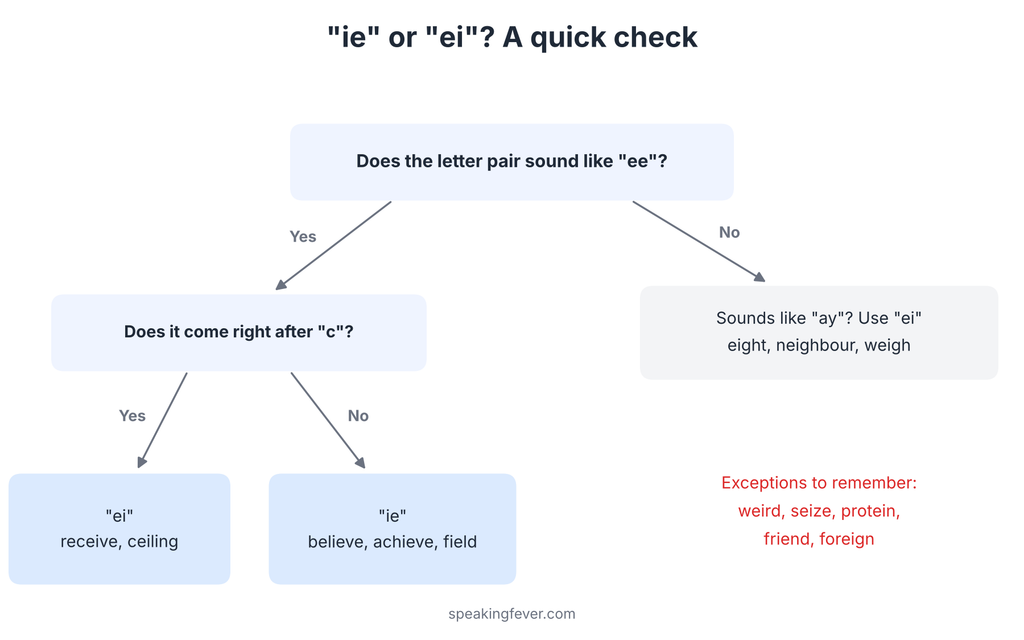
- “i” before “e”, except after “c”: this works best for the “ee” sound: believe, field, but receive. Exceptions include weird, seize and protein.
- Double the last letter: run → running, stop → stopped, begin → beginning. Not when the stress is at the start: visit → visited. In British English, a final “l” after one vowel is doubled anyway: travel → travelling.
- Drop the silent “e” before a vowel: make → making, but hope → hopeful. Exceptions include argue → argument and true → truly.
- Change “y” to “i”: happy → happiness, try → tried, but trying and played.
- “-ful” has one “l”: beautiful, careful, grateful. The same goes for always and already.
- “-able” or “-ible”: -able often follows a full word (acceptable), and -ible often does not (visible). Check new words in a dictionary.
British vs American English Spelling: Which Should You Use in India?
Use British spelling. Indian English generally follows the British style, for example colour, travelling, practise (as a verb) and realise.
| British (used in India) | American |
| colour, favourite | color, favorite |
| centre, metre | center, meter |
| travelling, cancelled | traveling, canceled |
| programme (a TV programme) | program |
| catalogue | catalog |
| defence | defense |
| licence (noun), license (verb) | license (noun and verb) |
| practice (noun), practise (verb) | practice (noun and verb) |
Neither style is wrong, but do not mix them in one piece of writing. If your computer marks British spellings as errors, set the spell checker to English (India) or English (UK).
For IELTS: both British and American spellings are accepted, but you should stay consistent. A misspelled answer in the Listening or Reading test is marked wrong, even if you heard or understood it correctly. If you are preparing for the exam, our IELTS preparation course covers all four modules, including Listening.
Spell Checkers and Grammar Correction Tools: What They Catch and Miss
A spell checker compares each word you type with a dictionary. Grammar correction and English correction tools go further and look at the whole sentence. Both are useful, but neither one can replace knowing the spelling yourself.
| A spell checker usually catches | It often misses |
| Typos such as “recieve” or “definately” | Real words used wrongly, such as “their” for “there” |
| Missing or extra letters (“tommorow”) | Confused pairs such as affect/effect and lose/loose |
| Repeated words (“the the”) | Indian names and places, which it may wrongly mark as errors |
Grammar correction tools can also fix tenses, articles and word order, but they sometimes change your meaning or suggest American spelling when you want British. And they cannot help you in a handwritten exam, or a live conversation such as a job interview.
How to use these tools to actually improve your spelling:
- Write first, then check, and read each suggestion before you accept it.
- Note every word the tool corrects, and learn it with a memory trick from the table above.
- Set the tool’s language to English (India) or English (UK).
Quick Spelling Quiz: Test Yourself
Choose the correct English spelling in each pair, then check your answers below.
- seperate / separate
- definately / definitely
- recieve / receive
- accommodate / accomodate
- Febuary / February
- wierd / weird
Answers: 1. separate, 2. definitely, 3. receive, 4. accommodate, 5. February, 6. weird. Got one wrong? Add it to your mistake list and learn it with its memory trick.
How to Improve Your English Spelling: 5 Daily Habits
Good spelling is mostly a habit built through small daily steps.
These habits work for children too. If you are helping a child, our spoken English classes for kids include a module on vocabulary and sentence formation.
- Read every day. Even 15 minutes of English news or stories helps, because seeing a word often fixes its shape in your memory.
- Keep a personal mistake list. Write down every word you get wrong, 10–15 words at a time.
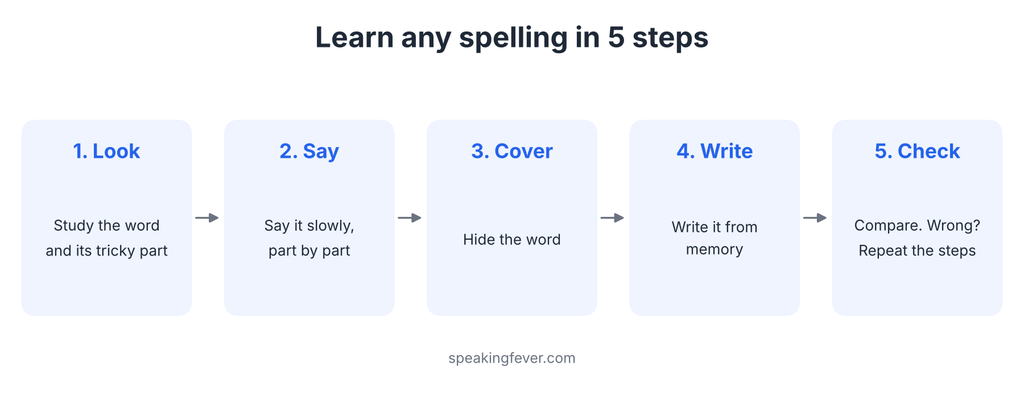
- Use “look, say, cover, write, check”. Look at the word, say it, cover it, write it from memory, then check it.
- Learn word families. If you know “know”, you can spell knowledge. If you know “science”, conscience is easier.
- Use new words when you speak and write. A word you use in real sentences is easier to remember. Our intermediate spoken English course helps you practise using new words in real conversations.
How Speaking Fever Can Help?
Disclosure: Speaking Fever is our own platform.
Speaking Fever’s live 1-to-1 online classes are 35 minutes long, and each course builds vocabulary step by step:
- Beginners can start with our basic English speaking course, which covers everyday vocabulary, essential grammar and sentence formation.
- Working professionals who write emails and reports can join our Business English course, which includes a module on business email and professional writing.
Conclusion
Most of your spelling mistakes probably come from a handful of words and a few patterns. Start with the 30 words in this guide and their memory tricks, add the six rules, and follow British spelling consistently. Use a spell checker to find your mistakes, not to hide them, and the words you search for today will soon be words you never need to check.
Want to use English words with confidence, not just spell them? Book a demo class with a Speaking Fever trainer and find the right course for your level.
Reach us via
Book Your Slot with Our Counsellor:
FAQs
What is the most commonly misspelled word in English?
There is no single official answer, because every list uses different data. Words that appear on many of these lists include definitely, separate, necessary, accommodate and embarrass.
How can I improve my English spelling quickly?
Keep a short list of the words you get wrong, learn each one with a memory trick, and test yourself every week. Reading daily and learning a few spelling rules will fix many words at once.
Is “i before e except after c” always true?
No. It works for many words where the sound is “ee”, such as believe and receive, but there are exceptions such as weird, seize and foreign.
Should I use British or American spelling in India?
Use British spelling, such as colour and travelling, because Indian English generally follows the British style. Whichever you choose, stay consistent in one piece of writing.
Can a spell checker fix all my spelling mistakes?
No. A spell checker catches typos, but it misses real words used wrongly, such as their/there or affect/effect. You still need to proofread your work.
Do spelling mistakes matter in IELTS?
Yes. A misspelled answer in the IELTS Listening or Reading test is marked wrong. Both British and American spellings are accepted, as long as you stay consistent.
What is the correct spelling of Wednesday?
W-e-d-n-e-s-d-a-y. The first “d” is silent when you say it, so say it slowly as “Wed-nes-day” when you write it.