
100 Speech Topics for Students (School & College, 1-3 Minutes)

Key Takeaways
The best speech topics for students are simple, personal and easy to explain with one example. Below are 100 topics sorted by level and time, from Class 1 to college.
- For kids (Classes 1–5): pick a topic they can see or touch, like “My favourite animal” or “Why I love my grandparents”.
- For school students (Classes 6–12): pick a topic with one clear opinion, like “Is homework helpful?” or “Should mobile phones be allowed in school?”
- For college students: pick topics about careers, technology and society, and practise extempore topics where you get only 1–2 minutes to think.
- How long is the speech? At a comfortable pace of about 100–130 words a minute, a 1-minute speech is about 100–130 words, a 2-minute speech is about 200–260 words and a 3-minute speech is about 300–390 words.
- Simple structure that always works: one hook, two or three points with an example each, and a one-line ending.
Introduction
Finding a good topic is often harder than giving the speech. Many lists online mix topics for 6-year-olds with debates on economics, and very few tell you how long each speech should be.
This guide fixes that. Every topic below is grouped by class level, and you will also find 1, 2 and 3 minute speech topics, extempore topics for college students, talking points for popular topics, a simple way to plan any speech and a short sample speech you can follow.
Table of Content
How to Choose a Speech Topic
A good speech topic is one you can talk about with real examples, not one that only sounds impressive. Ask yourself three questions:
- Do I know enough about it? You should be able to give two real examples.
- Does it suit my audience? Classmates like school life and technology; judges like a clear opinion.
- Does it fit my time? “Pollution” is too big for 2 minutes. “Why our school should ban plastic bottles” fits well.
How long is a 1, 2 or 3 minute speech?
Most people speak at about 130 words a minute, and slow down to about 100–120 words a minute when presenting (Omni Calculator). Use this as a guide when you write:
| Speech length | Words to write | Best for |
| 1 minute | About 100–130 | Kids, assembly thoughts, self-introductions |
| 2 minutes | About 200–260 | School speech competitions, class activities |
| 3 minutes | About 300–390 | Senior classes, college events, elocution |
100 Speech Topics for Students
The topics are grouped by level. Question topics suit opinion speeches; the rest work as simple talks or stories.
Speech Topics for Kids (Classes 1–5)
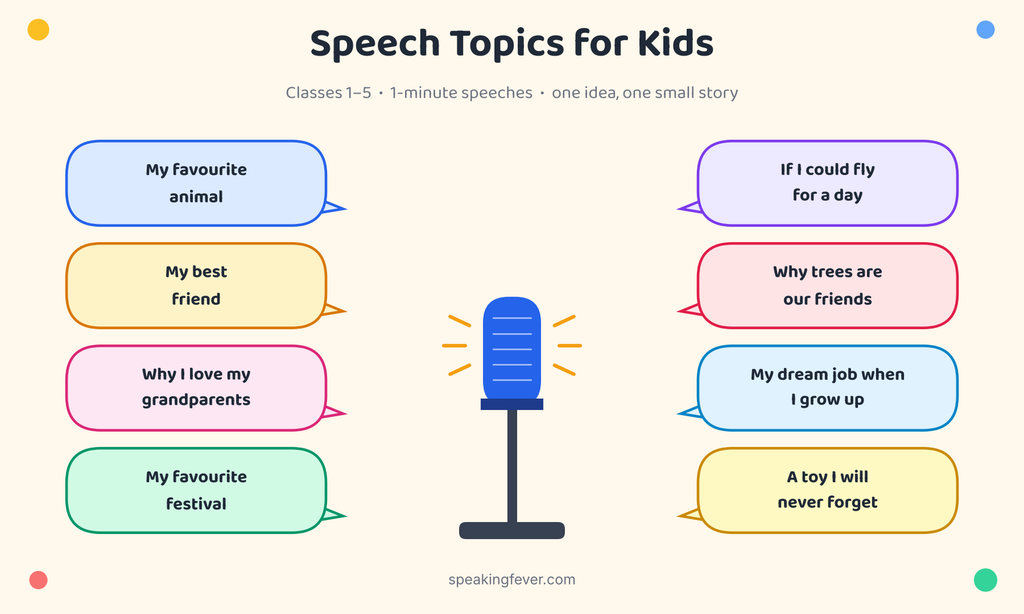
Short, personal topics help young children speak without fear. One idea and one small story is enough.
- My favourite animal
- My best friend
- Why I love my grandparents
- My favourite festival
- My school
- If I could fly for a day
- Why we should be kind to animals
- My favourite book or story
- The best day of my life
- Why trees are our friends
- My dream job when I grow up
- How I help at home
- My favourite season
- Why we should drink water and eat fruits
- A toy I will never forget
If your child freezes on stage, short and regular practice helps more than one big rehearsal. Speaking Fever’s public speaking course for kids uses short speeches, show-and-tell and storytelling for children aged 5–15.
Want your child to give their first speech with confidence? Book a trial public speaking class and let a Speaking Fever trainer practise a topic from this list with them.
English Speech Topics for School Students: Middle School (Classes 6–8)
At this age, students can share an opinion and back it up with one or two reasons.
- Is homework helpful?
- The importance of reading every day
- My role model and why
- Should children have pocket money?
- Why sports are as important as studies
- How to be a good friend
- Save water, save life
- The best lesson my teacher taught me
- Online games: fun or a waste of time?
- Why we should respect every job
- The importance of good manners
- How to beat exam stress
- Why I love my country
- Junk food vs healthy food
- What I would change in my school
English Speech Topics for School Students: High School (Classes 9–12)
Senior students should take a clear side, give evidence and answer the other side in one line.
- Should mobile phones be allowed in school?
- Are marks the best measure of a student?
- Social media: friend or enemy for teenagers?
- Why mental health matters in school
- Should coding be taught to every student?
- How climate change affects our daily life
- Are board exams too stressful?
- The role of youth in building the nation
- Should school uniforms be compulsory?
- Is AI a good study partner?
- Why every student should learn first aid
- Reading books vs watching videos to learn
- The importance of saying “no” to peer pressure
- Should students do part-time jobs?
- How to choose the right career after school
Speech Topics for College Students
College topics work best when you connect them to careers, technology or society and use a real example or number.
- Is a degree still enough to get a good job?
- The skills employers want that colleges do not teach
- Work from home: the future of work?
- Should college attendance be compulsory?
- How AI is changing the jobs we will do
- Startup or a stable job: what should graduates choose?
- Is social media influencing our decisions too much?
- Why financial literacy should be taught in college
- The pressure to succeed in your twenties
- Fast fashion and its cost to the planet
- Should internships be paid?
- Learning from failure
- Is studying abroad worth it?
- The importance of soft skills in a tech world
- Digital privacy: how much should we share online?
Topics like these often come up in placement interviews too. Speaking Fever’s job interview English speaking course includes mock interview practice with personal feedback.
Extempore Topics for College Students
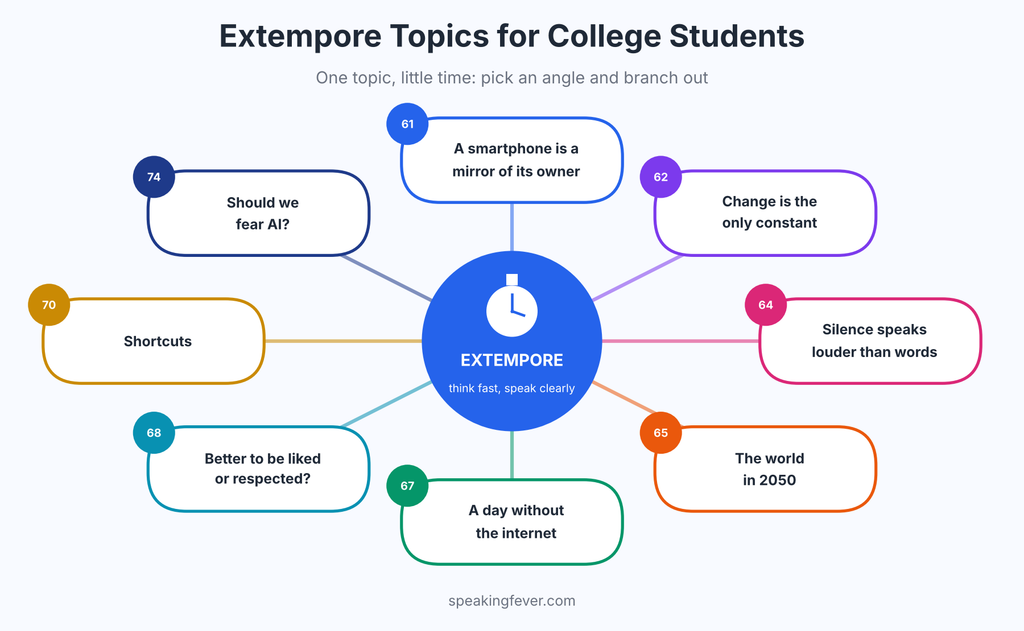
In extempore, you get a topic on the spot and only a short time to think. These topics are open on purpose, so you can choose your own angle.
- A smartphone is a mirror of its owner
- Change is the only constant
- If I were the principal for a day
- Silence speaks louder than words
- The world in 2050
- Money cannot buy happiness
- A day without the internet
- Is it better to be liked or respected?
- The colour that describes my generation
- Shortcuts
- Life is a race
- What a traffic signal teaches us
- Old is gold
- Should we fear AI?
- One thing I would teach every leader
1-Minute Speech Topics
These are quick topics for assembly, class activities or a short self-introduction round.
- Introduce yourself in one minute
- My favourite hobby
- A habit I want to change
- The best advice I have received
- Why I smile every day
- One thing I am grateful for
- My favourite place in my city
- A small act of kindness
- What makes a good teacher
- The best gift I ever received
2-Minute Speech Topics
These topics are wide enough for two or three points but small enough to finish in 2 minutes.
- The power of a positive attitude
- Time management for students
- Why every student should play a sport
- The importance of learning English
- Discipline: the key to success
- A world without plastic
- Why we should read the newspaper
- My hero in real life
- How technology has changed education
- Hard work vs smart work
- Why failure is not the end
- The importance of trees in our cities
- Cleanliness begins at home
- Why kindness is a strength
- The one skill every student needs: communication
3-Minute Speech Topics
For a 3-minute speech, pick a topic from the high school (31–45) or college (46–60) lists, such as 33, 50 or 57. Write about 300–390 words and add one short story.
Bonus: Speech Topics for Special Days
- Independence Day (15 August): What freedom means to me
- Republic Day (26 January): Why our Constitution matters to every student
- Gandhi Jayanti (2 October): Lessons from Gandhiji’s life for students today
- Teachers’ Day (5 September): A teacher who changed my life
- Children’s Day (14 November): What makes childhood special
How to Write a 2-Minute Speech (With a Sample)
A 2-minute speech needs about 200–260 words and just four parts. Write it like this:
| Part | Time | What to say |
| Hook | 10–15 seconds | A question, a short story or a surprising fact |
| Main idea | 10 seconds | Your topic and your opinion in one sentence |
| 2–3 points | 70–80 seconds | One reason and one example for each point |
| Ending | 15–20 seconds | Repeat your message and end with one memorable line |
Sample 2-minute speech: “Why Failure Is Not the End”
(About 210 words, close to 2 minutes at a calm pace)
Good morning, everyone. Raise your hand if you have ever failed a test. Now look around. Almost every hand is up. So today, I want to tell you why failure is not the end.
First, failure shows us what we need to learn. When I scored poorly in my maths test last year, I was upset. But when I checked my paper, I saw that I kept making the same mistake in fractions. I practised only that for two weeks, and my next score went up by 20 marks.
Second, failure builds courage. Every time we fall and stand up again, we become a little less afraid. A child learning to ride a bicycle falls many times, but nobody tells them to stop. We should treat our own mistakes the same way.
Third, many successful people failed first. Thomas Edison tried many different materials before he found one that worked for his light bulb. He is often quoted as saying that he had not failed, but had found ways that did not work.
So the next time you fail, do not hide your paper or give up. Ask yourself one question: “What can I learn from this?” Because failure is not the opposite of success. It is a part of it.
Thank you.
Want feedback on your own speech? Book a trial class and deliver it live to a Speaking Fever trainer, who will tell you what to improve.
Tips for Extempore Speeches
In an extempore round, you usually get your topic just before you speak. Time is short. Rules change from event to event, so always check the preparation time and speaking time first.
- Note three key words, not full sentences: one for the opening, one for your main point and one for the ending.
- Pick one simple angle fast. For “Shortcuts”, talk about shortcuts in studies, in life or on the road, and stay with it.
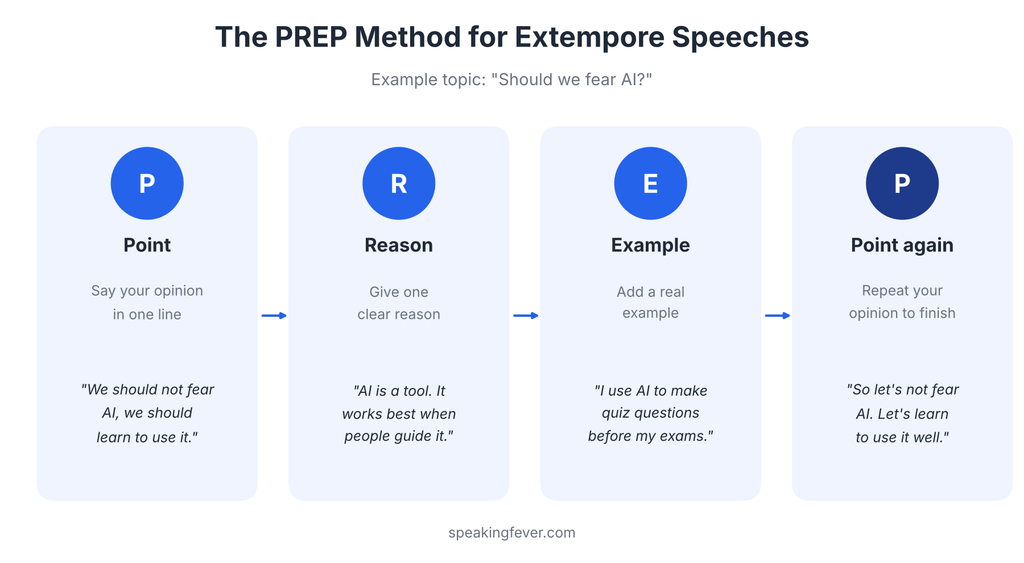
- Use the PREP method: Point, Reason, Example, Point again (Lumen Learning).
- Stuck? Try past, present and future. Say what the topic meant before, what it means today and what could happen next.
- Never apologise. Skip “I don’t know much about this” and start with a confident first line.
How to Speak With Confidence
For most students, stage fear gets smaller with regular practice. These habits help every student:
- Practise aloud, to a mirror or your phone camera.
- Slow down and pause after each point.
- Look at three friendly faces, not the floor.
- Learn your first and last lines by heart.
- Get feedback from a teacher or trainer.
If you are a college student or a working adult who still feels nervous on stage, Speaking Fever’s online public speaking course offers live 1-to-1 classes of 35 minutes, with practice in speech structure, impromptu speaking and body language.
Conclusion
The right speech topic fits your age, your audience and your time limit. Kids do best with personal topics, school students with everyday opinions, and college students with careers, technology and extempore topics. Whatever you pick, use a hook, two or three points with real examples and a strong last line, and write about 100–130 words a minute.
Pick one topic today and speak on it for one minute, then try a new one tomorrow. Small, regular practice turns a nervous speaker into a confident one. If you need help with everyday spoken English too, Speaking Fever’s online English speaking course build fluency through live 1-to-1 practice.
Ready to speak on stage without fear? Book your ₹11 demo class with Speaking Fever and start practising with a real trainer this week.
Reach us via
Book Your Slot with Our Counsellor:
Frequently Asked Questions (FAQs)
1. What are some good speech topics for students?
Good speech topics for students are ones they can explain with real examples, such as “Is homework helpful?” or “Should mobile phones be allowed in school?” Pick one that suits your class level and time limit.
2. What are easy speech topics for kids?
Easy speech topics for kids include “My favourite animal”, “My best friend”, “My school” and “Why trees are our friends”. Young children speak best about things they see and love every day.
3. How many words is a 2-minute speech?
A 2-minute speech is about 200–260 words, based on a speaking pace of about 100–130 words a minute.
4. How many words is a 1-minute speech?
A 1-minute speech is about 100–130 words. That is enough for one main idea, one example and a closing line.
5. What is the difference between a speech and an extempore?
In a prepared speech, you know the topic in advance and can write and practise it. In an extempore, you get the topic on the spot and have only a short time to think before you speak.
6. How do I prepare for extempore topics in college?
Practise with a random topic every day. Note three key words, pick one angle and follow the PREP method: Point, Reason, Example, Point again.
7. How do I start a speech in an interesting way?
Start with a question, a short real story or a surprising fact. Avoid long greetings and “Today I am going to speak about” as your only opening line.
8. How can I overcome stage fear while giving a speech?
Practise aloud several times, learn your first and last lines, slow down and look at a few friendly faces. Feedback from a teacher or trainer builds confidence fastest.