Business English Phrases for Emails and Meetings: Cheat Sheet (Free PDF)

Quick Verdict
Good business English is short, polite and clear. You don’t need fancy words. You need a small set of tested phrases for the moments that happen every day at work. This cheat sheet gives you those phrases, grouped by situation, with a free PDF to keep on your desk.
| Emails: open with a clear purpose (“I’m writing to…”), make requests softly (“Could you please…”), and end with a clear next step (“Please let me know by Friday”). Meetings: use set phrases to open, give opinions, disagree politely, ask for clarity and close with action points. Sound polite, not stiff: “Could you…” and “Would it be possible to…” work better than “Kindly do the needful”. Be specific: give a date and time instead of “ASAP”. Saying no: always offer an alternative (“I can’t do Friday, but I can send it on Monday”). Practise out loud: reading phrases is not enough. Use 5 new phrases a week in real emails and calls. |
Introduction
Business English is the English used at work: in emails, meetings, calls and presentations. Good business English communication depends on clear, polite standard phrases, not difficult words. This cheat sheet gives you 100+ of them, grouped by situation.
Knowledge workers spend 88% of their work week communicating (Grammarly), and about 361.6 billion emails were sent and received every day in 2024 (Radicati Group). That is why many professionals now take a business English course alongside their job.
Whether you are writing to a client, joining a team call or leading a meeting, these phrases help you sound clear and confident. Each section is grouped by situation, so you can find the right line in seconds. You can also download everything as a free PDF and keep it next to your inbox.
Table of Content
Business English phrases at a glance
| Situation | Go-to phrase |
|---|---|
| Start an email | I’m writing to… / I’m reaching out about… |
| Ask for something | Could you please…? / Would it be possible to…? |
| Follow up | Just following up on my email from Monday about… |
| Send a file | I’ve attached… for your review. |
| End an email | Please let me know if you have any questions. |
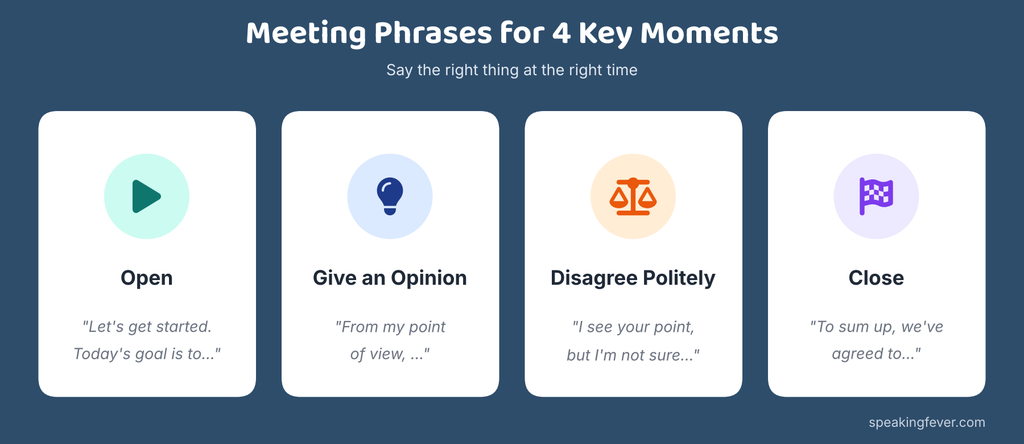
| Open a meeting | Let’s get started. Today’s goal is to… |
| Give an opinion | From my point of view… / I’d suggest… |
| Disagree politely | I see your point, but I’m not sure that… |
| Ask for clarity | Could you say a bit more about…? |
| Close a meeting | To sum up, … will do … by … |
Business Email Phrases by Situation
A good business email has three parts: why you are writing, what you need, and what happens next. Use these phrases for each part.
Formal or neutral? Use formal phrases (Dear…, I would appreciate…, Kind regards) with new clients, senior leaders and complaints. Use neutral phrases (Hi…, Could you…, Thanks) with colleagues and clients you know well.
Before you write: subject lines
A clear subject line tells the reader what you need before they open the email. Keep it short and put the action or date first.
- Meeting request: Call on Thursday to review the Q3 budget?
- Follow-up: Follow-up: proposal sent on 5 November
- Action needed: Action needed: approve invoice by Friday
- Update: Update: website launch moved to 1 December
- For information: FYI: new leave policy from January
1. Greetings
- Formal (new client, senior person): Dear Ms Sharma, / Dear Mr Patel,
- Neutral (colleague, known client): Hi Ananya, / Hello team,
- Name unknown: Dear Hiring Team, / Dear Customer Support Team,
Tip: avoid “To whom it may concern” when you can find a name or team. It sounds old-fashioned.
2. Opening lines
- I hope you’re well.
- Thank you for your email.
- Thanks for getting back to me so quickly.
- I’m writing to ask about…
- I’m reaching out regarding…
- Following our call yesterday, …
3. Making requests
- Could you please send me…?
- Would it be possible to…?
- I’d appreciate it if you could…
- Could you let me know by Thursday, 5 pm?
- When you have a moment, could you…?
4. Sharing files and information
- I’ve attached the report for your review.
- Please see the attached proposal.
- Here is the link to the shared folder.
- Just to update you, …
- I’m happy to share that…
5. Following up and reminders
- Just following up on my email from Monday about…
- I wanted to check whether you had a chance to look at…
- A gentle reminder that the deadline is Friday.
- Is there any update on…?
6. Scheduling meetings
- Are you available for a 30-minute call this week?
- Would Tuesday at 11 am or Wednesday at 3 pm work for you?
- I’ve sent a calendar invite for…
- Could we move our meeting to Friday?
- Sorry, I can’t make it at that time. Could we try…?
7. Apologising and fixing problems
- Sorry for the delay in getting back to you.
- Thank you for your patience.
- I apologise for the mistake in the invoice. Here is the corrected version.
- We’re looking into this and will update you by tomorrow.
8. Thanking
- Thank you for your quick reply.
- I really appreciate your help with…
- Thanks for taking the time to…
- Your feedback was very helpful.
9. Saying no politely
- Thank you for thinking of me, but I won’t be able to…
- Unfortunately, we can’t offer that discount, but we could…
- I’m afraid I can’t take this on this week. Could we look at next week?
- That won’t be possible by Friday, but I can send it by Monday.
10. Sharing bad news
- I’m sorry to let you know that…
- Unfortunately, the delivery will be delayed by two days.
- I wanted to let you know early that…
- Here’s what we’re doing to fix it: …
11. Closing lines and sign-offs
- Please let me know if you have any questions.
- I look forward to hearing from you.
- Thanks again for your help.
- Formal: Kind regards, / Best regards,
- Neutral: Best, / Thanks,
If you want your emails and calls to sound natural rather than copied from a textbook, these tips on how to speak English professionally can help.
Book a demo class with a Speaking Fever business English trainer.
Business Meeting Phrases by Situation
Meetings move fast, so short set phrases help you speak up without searching for words. These work for in-person meetings and video calls on Zoom, Google Meet or Microsoft Teams.
1. Opening a meeting
- Good morning, everyone. Let’s get started.
- Thanks for joining. Today’s goal is to…
- We have 30 minutes, so let’s go through the agenda.
- Before we begin, does everyone have the slides?
- Let’s do a quick round of introductions.
- Hi, I’m Neha. I lead the design team, and I’ll be working on this project.
2. Giving updates
- Here’s a quick update on…
- We’re on track to finish by…
- We’re a little behind because…, but we expect to catch up by…
- The main thing to note is…
3. Sharing your opinion
- From my point of view, …
- I’d suggest that we…
- In my experience, …
- One option could be to…
4. Agreeing
- I agree with Rahul on this.
- That makes sense.
- That’s a good point.
- I’m happy to go ahead with that.
5. Disagreeing politely
- I see your point, but I’m not sure that…
- I understand, but have we thought about…?
- That’s a fair point. However, …
- Could we look at this another way?
6. Interrupting and joining in
- Sorry to interrupt, but could I add something?
- If I could just come in here…
- Can I add one quick point before we move on?
- Sorry, go ahead. (when two people start talking at once on a call)
7. Asking for clarity
- Could you say a bit more about…?
- Just to make sure I understand, you mean…?
- Sorry, could you repeat that? The audio cut out.
- What would that mean for our timeline?
8. Keeping the meeting on track
- Let’s come back to the main point.
- Can we discuss that offline after the meeting?
- In the interest of time, let’s move on to…
- Let’s park that for now and add it to the next agenda.
9. Closing a meeting
- To sum up, we’ve agreed to…
- So the next steps are: … will do … by …
- I’ll send the meeting notes by end of day.
- Thanks, everyone. Have a good day.
10. Video and online calls
Online calls bring their own problems, like bad audio and screen sharing. These phrases help you handle them calmly. For one-to-one calls, these tips on how to speak English confidently on the phone also help.
- Can everyone hear me okay?
- I think you’re on mute.
- Can everyone see my screen?
- Sorry, you broke up a little. Could you repeat the last part?
- My connection is unstable, so I’ll turn off my camera.
- I’ll put the link in the chat.
Many of the same skills help in interviews and team discussions. Here are more English speaking tips for group discussions you can use in meetings too.
Phrases to Avoid (and What to Say Instead)
Some phrases sound too stiff, vague or rude to readers in other countries. Others are regional and confuse international teams. Swap them for these clearer options.
| Avoid | Say instead | Why |
|---|---|---|
| Send it ASAP. | Could you send it by 3 pm today? | A clear time avoids confusion |
| As per my last email… | As I mentioned on Monday, … | Can sound annoyed |
| You are wrong. | I see it a little differently. | Disagrees without blame |
| Hey! / Yo team | Hi Sam, / Hello team, | Too casual for most work emails |
| Dear Sir/Madam (when you know the name) | Dear Ms Lee, | Using the name shows care |
| I just wanted to maybe ask if you could possibly… | Could you please…? | Too many soft words sound unsure |
| Please do the needful. | Could you please approve the leave request? | Regional phrase; it doesn’t say what you need |
| Kindly revert. | Please let me know. / Could you reply by Friday? | Outside South Asia, “revert” means “go back to” |
| Let’s discuss about this. | Let’s discuss this. | “Discuss” does not take “about” |
| Please find attached herewith the file for your kind perusal. | I’ve attached the file. | Shorter and more natural |
| Does that make sense? | Please let me know if you have any questions. | Can sound like you doubt the reader |
Small grammar slips like “discuss about” are easy to fix once you know the essential grammar rules every English speaker must know.
Sample Email and Meeting Script
Here is how the phrases fit together in real situations. Change the names, dates and details to match your work.
Sample email: following up after a meeting
Subject: Next steps from today’s website review
Hi Priya,
Thanks for your time in today’s meeting. As agreed, here are the next steps:
- Our team will share the new homepage design by Thursday, 19 November.
- Could you please send the updated product photos by Wednesday?
- We’ll review everything together on our call next Monday at 11 am.
I’ve attached the meeting notes for your reference. Please let me know if I missed anything.
Best regards, Arjun
Sample meeting script: a 2-minute opening and close
Opening: Good morning, everyone, and thanks for joining. We have 30 minutes today. Our goal is to agree on the launch date. First, Meera will give a quick update, then we’ll discuss the two date options.
During: Sorry to interrupt, but could I add something? I see the benefit of launching early, but I’m not sure the testing will be complete. Could we look at a one-week buffer?
Closing: To sum up, we’ve agreed to launch on 1 December. Meera will finish testing by 25 November, and I’ll send the notes by end of day. Thanks, everyone.
How to Practise and Use This Cheat Sheet
A cheat sheet helps only if the phrases come out naturally when you need them. Corporate English speaking improves fastest with short, regular practice.
- Pick 5 phrases a week. Choose ones you need often, such as follow-ups and polite disagreement.
- Use them the same day. Put one phrase into a real email or say it in your next stand-up.
- Say them out loud. Read each phrase aloud 5 times so it feels natural on calls.
- Record a mock meeting. Record a 2-minute update on your phone, then listen for filler words and long pauses.
- Role-play hard moments. Practise disagreeing with a senior or handling an unhappy client with a friend or trainer.
- Keep the PDF open. Keep it next to your inbox and look at it before important emails and calls.
If you freeze when it’s time to speak, these tips on how to overcome hesitation in English speaking as a working professional can help you build confidence step by step.
Download the Free PDF Cheat Sheet
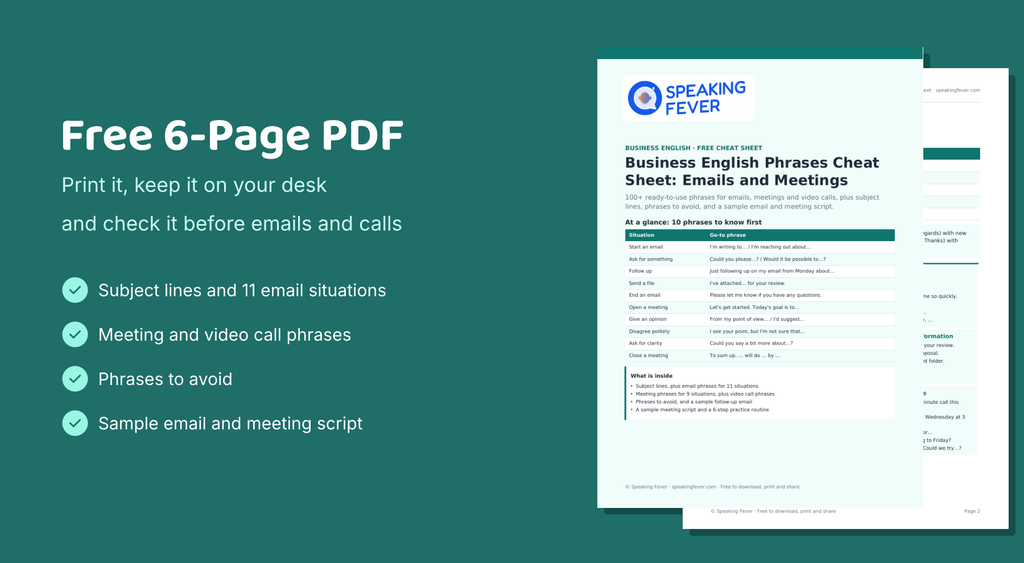
Get all the email and meeting phrases from this guide on one printable PDF. The 6-page PDF covers subject lines, email phrases for 11 situations, meeting and video call phrases, the “avoid and say instead” list, a sample email and meeting script, and a practice routine.
Click here – Download the Business English Phrases Cheat Sheet (Free PDF)
Practise These Phrases With a Trainer
Disclosure: Speaking Fever is our own platform.
A cheat sheet gives you the words. Live practice helps you use them under pressure. Speaking Fever’s Business English course builds professional English speaking through live 1-to-1 online classes.
- Real work situations: business emails, meetings, presentations, client calls and negotiations.
- Mock meetings and role-plays: practise disagreeing, giving updates and handling questions with a trainer.
- 35-minute 1-to-1 classes: fit them around your working day.
- Plans from ₹3,999 for 1 month, ₹7,499 for 2 months and ₹9,999 for 3 months.
Want to sound confident in your next meeting? Book a demo class and practise these phrases with a trainer.
Conclusion
Good business English and communication is not about long words. It is about clear, polite phrases you can use without thinking: a clear purpose in your emails, a specific date instead of “ASAP”, and a calm way to disagree in meetings. Start with the phrases you need most, practise 5 a week, and keep the free PDF next to your inbox. Within a few weeks, your emails will be shorter and your meetings smoother.
Remember that the best business English is simple: one clear purpose per email, one clear action per meeting, and a polite tone throughout. When you need to say no or share bad news, always offer an alternative or a next step. On video calls, a few ready phrases for audio and screen-sharing problems keep you calm and in control. Most of all, practise speaking these phrases out loud, because confident professional English speaking comes from use, not just reading. If you want structured practice, compare these English speaking courses for working professionals.
Ready to speak business English with confidence? Book your demo class today.
Reach us via
Book Your Slot with Our Trainers:
FAQs
1. What is business English?
Business English is the English used at work: in emails, meetings, presentations, calls and negotiations. It focuses on being clear, polite and professional rather than using difficult vocabulary.
2. What are the most useful business email phrases?
“I’m writing to…”, “Could you please…?”, “I’ve attached…”, “Just following up on…” and “Please let me know if you have any questions” cover most everyday emails.
3. How can I make my emails sound more professional?
State your purpose in the first line, keep sentences short, make requests politely with “Could you…”, give a clear deadline, and end with the next step. Avoid slang, all capital letters and vague words like “ASAP”.
4. How do I disagree politely in a meeting?
Acknowledge the other person’s point first, then share your view. For example: “I see your point, but I’m not sure that…” or “That’s a fair point. However, …”
5. Is “Please do the needful” correct English?
It is common in India and parts of South Asia, but it can confuse people in other countries because it doesn’t say what you want. Say the exact action instead, such as “Could you please approve the invoice?”
6. What is the difference between business English and general English?
General English covers everyday topics like shopping, travel and hobbies. Business English focuses on work tasks such as writing emails, running meetings and talking to clients, and it uses a more formal, polite tone.
7. How can I improve my corporate English speaking skills?
Practise a few phrases each week, use them in real emails and calls, record yourself, and role-play meetings. Regular English conversation practice online with a trainer gives you feedback you can’t get from reading alone.
8. Can I use these phrases in job interviews?
Yes. Phrases for sharing opinions, asking for clarity and closing politely also work in interviews. For interview-specific language, see these English phrases for job interviews.