
Key Takeaways
The best way to end a speech is to sum up your main message in one line, then finish with a strong closing line before you say thank you.
- Use one of 5 proven closers: a call to action, a quote, a callback to your opening, a short story or a powerful question.
- Signal the end clearly with phrases like “To sum up” or “Before I finish”.
- Keep it short. Your conclusion should take about 30–60 seconds.
- Say “thank you” last, after your closing line, not instead of it.
- For school speeches, end with a message for your classmates, then thank the principal and teachers.
- For presentations, end with a clear next step, then take questions, then give one final line.
Introduction
On 12 June 2005, Steve Jobs ended his Stanford graduation speech with four words he had borrowed from an old magazine: “Stay hungry. Stay foolish.” Those four words became the name people remember the speech by, and the Steve Jobs Archive even titled its exhibit about the speech after them.
That is the power of a good ending. Yet many speakers plan their opening carefully, then finish with “That’s all I have” or “So, yeah… thank you.” This guide shows you how to end a speech with 15 ready closing lines, ending lines for students, thank you lines after a speech, and simple steps to conclude a presentation at work.
Table of Content
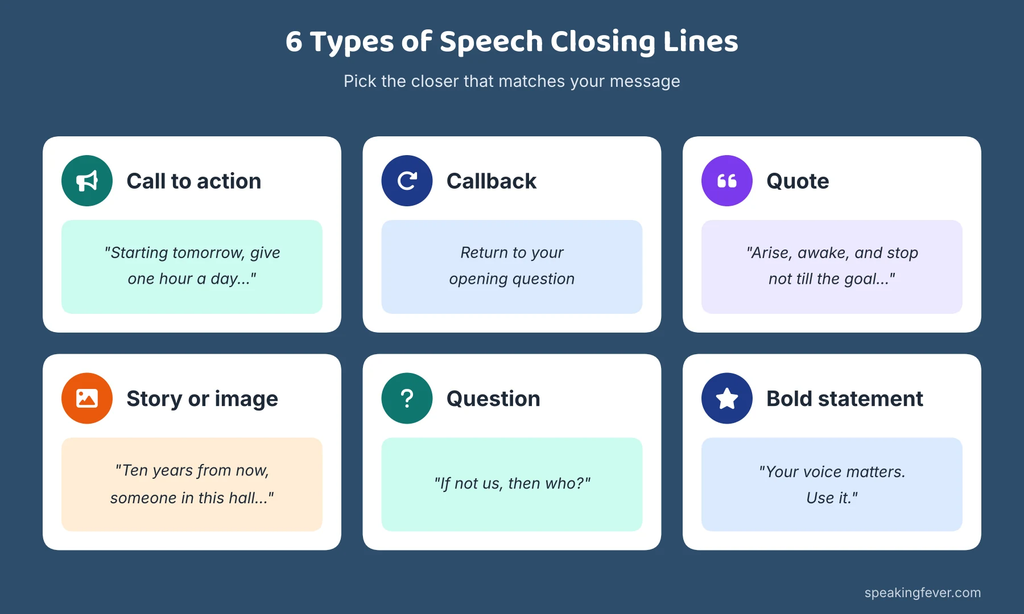
Speech closing lines at a glance
| Closing type | Best for | Example line |
|---|---|---|
| Call to action | Persuasive and motivational speeches | “Starting tomorrow, give one hour a day to the thing you keep postponing.” |
| Callback | Any speech with a strong opening | “At the start, I asked a question. Now ask yourself again.” |
| Quote | Student and inspirational speeches | “Arise, awake, and stop not till the goal is reached.” |
| Story or image | Annual day, graduation and farewell | “Ten years from now, someone in this hall will stand on a bigger stage.” |
| Question | Debates and social topics | “If not us, then who? And if not now, then when?” |
| Bold statement | Short speeches and competitions | “Your voice matters. Use it.” |
| Gratitude | Teachers’ Day and farewell | “We are who we are because of you.” |
Why the Ending of a Speech Matters
Two well-known ideas from psychology explain why your last lines count.
- The recency effect: In a classic 1962 memory study, psychologist Bennet Murdock found that people remember items at the end of a list much better than items in the middle. Your closing lines sit in that “end of the list” spot.
- The peak-end rule: Research by Nobel prize winner Daniel Kahneman and Barbara Fredrickson shows that people judge an experience mostly by its most intense moment and its end, not by the average of every moment.
So even if one part of your speech felt weak, a strong ending can change how people remember the whole thing.
15 Speech Closing Lines That Leave an Impact
These speech closing lines are grouped by type. Choose the one that matches your message, then change the words to fit your topic.
End with a call to action
A call to action tells the audience exactly what to do next. It works best for persuasive and motivational speeches.
- “Starting tomorrow, give one hour a day to the thing you keep postponing. One hour. That’s all I ask.”
- “Before you leave this hall, promise yourself one thing: you will never stay quiet when you know the answer.”
- “Carry a cloth bag tomorrow. If all of us do it, imagine how many plastic bags this school will save every single week.”
End with a callback to your opening
A callback repeats an idea, question or story from your first line. It makes your speech feel complete.
- “At the start, I asked how many of you checked your phone in the last ten minutes. Now ask yourself: will you check it again in the next ten?”
- “Remember the student who forgot every word on this stage last year? That student was me, and today I finished my speech.”
End with a quote
A short quote gives your message the weight of a famous voice. Pick one that sums up your main point.
- “As Swami Vivekananda said, ‘Arise, awake, and stop not till the goal is reached.’ Let’s not stop.”
- “Dr A.P.J. Abdul Kalam said, ‘Dream, dream, dream.’ Today, let’s add one more word: act.”
End with a short story or image
An image helps the audience picture the future you are talking about.
- “Ten years from now, someone in this hall will stand on a bigger stage. I hope they remember this one.”
- “Imagine a classroom where every student raises their hand without fear. We can build that classroom, starting today.”
End with a question
A question keeps people thinking after you stop speaking.
- “So the real question is not whether you can change. It is: when will you start?”
- “If not us, then who? And if not now, then when?”
End with a strong statement
A short, confident statement gives your speech a clear full stop.
- “Your voice matters. Use it.”
- “Marks open doors. Character keeps them open.”
- “The future of this country is sitting in this hall.”
End with gratitude
Use this when the occasion is about thanking people, such as Teachers’ Day or a farewell.
- “For every lesson, every correction and every second chance, thank you. We are who we are because of you.”
Need a topic to try these closers on? Pick one from our list of speech topics for students.
Ending Lines for Speech for Students
In Indian schools, many students end with “That’s all, thank you.” A better ending has three parts: a one-line summary, a closing line and a short thank-you.
Formula: summary + closing line + thank you.
| Occasion | Example ending lines |
|---|---|
| Morning assembly | “So tonight, put your phone away by 10 p.m. Your marks and your mood will thank you. Thank you, everyone.” |
| Independence Day or Republic Day | “Our freedom was earned by others. Protecting it is now our job. Thank you, and Jai Hind.” |
| Teachers’ Day | “Dear teachers, you taught us more than lessons. You taught us how to be good people. Happy Teachers’ Day, and thank you.” |
| Children’s Day | “Let’s stay curious, kind and brave, and make Chacha Nehru proud. Happy Children’s Day, and thank you.” |
| Farewell speech | “We may leave this school, but this school will never leave us. Thank you for everything.” |
| Speech competition | “Three minutes ago, I asked you to think differently. I hope you will. Thank you, respected judges.” |
| Student election | “Vote for a school where every voice is heard. Vote for me. Thank you.” |
For a full ready speech, see our Children’s Day speech for kids.
Thank you lines after a speech
A thank-you line should be short and warm. Use one of these after your closing line:
- “Thank you for listening.”
- “Thank you for your time and attention.”
- “Thank you all for being such a wonderful audience.”
- “I am grateful for this opportunity. Thank you.”
- “Thank you, respected principal, teachers and my dear friends.” (school events)
- “Thank you. I’m happy to take your questions now.” (presentations)
If you are giving a formal vote of thanks at an event, the format is different. In that case, you thank the chief guest, organisers and audience by name, one by one.
Preparing for a school speech or competition? Book a ₹11 demo class and practise your ending with a live trainer before the big day.
How to Conclude a Presentation at Work
Many presentations end on a slide that says “Thank You” or “Questions?”. A stronger way to conclude a presentation is to follow these four steps:
- Recap in one line: “So, we have one problem, two causes and one clear fix.”
- Give the next step: “I need your approval by Friday so we can start on Monday.”
- Take questions: “What questions do you have?” This works better than “Any questions?”, which often gets silence.
- Close again after Q&A: finish with one final line, so the meeting does not end on a random question. For example: “If we act this month, we can see results by next quarter. Thank you.”
For useful phrases to wrap up meetings and emails, see our business English email and meeting phrases.
How to Write and Deliver Your Ending?
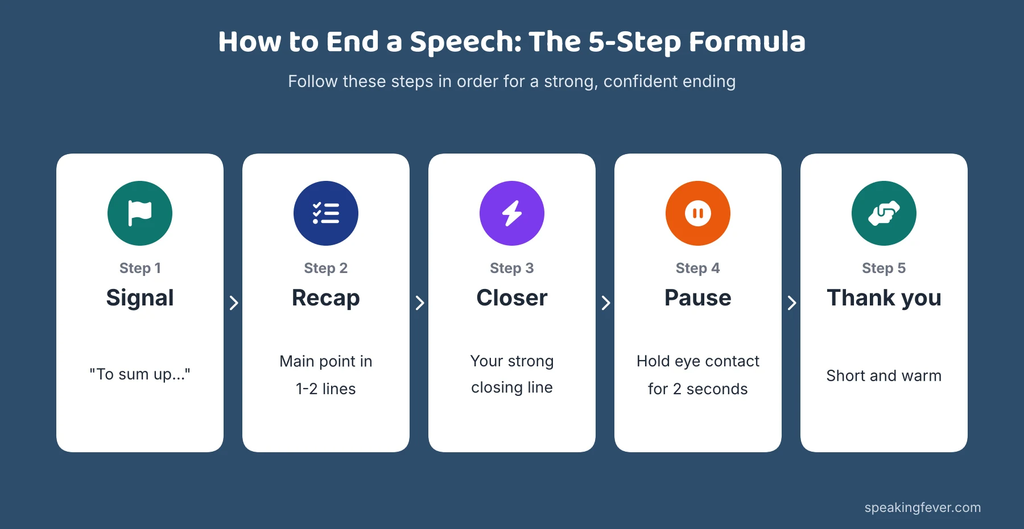
- Decide your one message. Ask yourself: what should people think, feel or do after my speech?
- Signal that you are finishing. Use phrases like “To sum up”, “In closing” or “Before I finish”. This helps the audience refocus.
- Recap briefly. Repeat your main point in one or two sentences. Do not repeat the whole speech.
- Deliver your closing line. Use one of the 15 closers above.
- Pause, then say thank you. Hold eye contact for two seconds after your last line, then thank the audience.
- Write it word for word and memorise it. Your ending should never depend on notes.
Mistakes to avoid
- Ending with “That’s all” or “That’s it”. It sounds like you ran out of things to say.
- Adding new points at the end. The conclusion is for wrapping up, not for starting a new idea.
- Apologising. Lines like “Sorry if I was boring” undo your hard work.
- Rushing off stage. Walking away while still speaking makes your ending feel weak.
- Saying “Any questions?” as your very last line. Always come back with one final closing sentence.
If your voice shakes at the end, these tips to beat stage fear can help you stay calm until the last word.
Practise Your Speech With a Live Trainer
Disclosure: Speaking Fever is our own platform.
A great closing line only works if you can deliver it with confidence. In Speaking Fever’s online public speaking course, certified trainers work with you 1-to-1 in live classes to practise speeches, presentations and strong endings.
Have a speech or presentation coming up? Book a ₹11 demo class and practise your ending with a trainer.
Conclusion
Knowing how to end a speech comes down to three moves: sum up your message in one line, deliver a strong closing line, and then say thank you. Choose a call to action, callback, quote, image, question or bold statement that fits your message, and memorise it word for word.
Your audience will forget many things you said in the middle. Make sure your last line is the one they remember. Pick a closer from this list today, and practise it out loud until it feels natural. If you want guided practice, compare these top online public speaking courses in India.
Reach us via
Book Your Slot with Our Trainer:
FAQs
How do I end a speech?
Signal that you are finishing, sum up your main message in one line, deliver a strong closing line, pause, and then say thank you.
What is a good closing line for a speech?
A good closing line is short and linked to your main message. For example: “Your voice matters. Use it.” or “If not us, then who? And if not now, then when?”
How should students end a speech in school?
End with a one-line message for your classmates, then thank the principal, teachers and friends. Avoid ending with “That’s all”.
What are some thank you lines after a speech?
Try “Thank you for listening”, “Thank you for your time and attention” or “Thank you all for being such a wonderful audience.”
Should I say thank you at the end of a speech?
Yes, but say it after your closing line, not instead of it. A short thank-you tells the audience you have finished.
How do I conclude a presentation?
Recap your main point, give a clear next step, take questions, and then finish with one final closing line.
How long should the conclusion of a speech be?
About 30–60 seconds is enough for most speeches. Keep the recap to one or two sentences.
What should I avoid when ending a speech?
Avoid ending with “That’s all”, adding new points, apologising, or walking off while still speaking.