
Public Speaking vs English Speaking: Differences, Skills & How to Improve Both

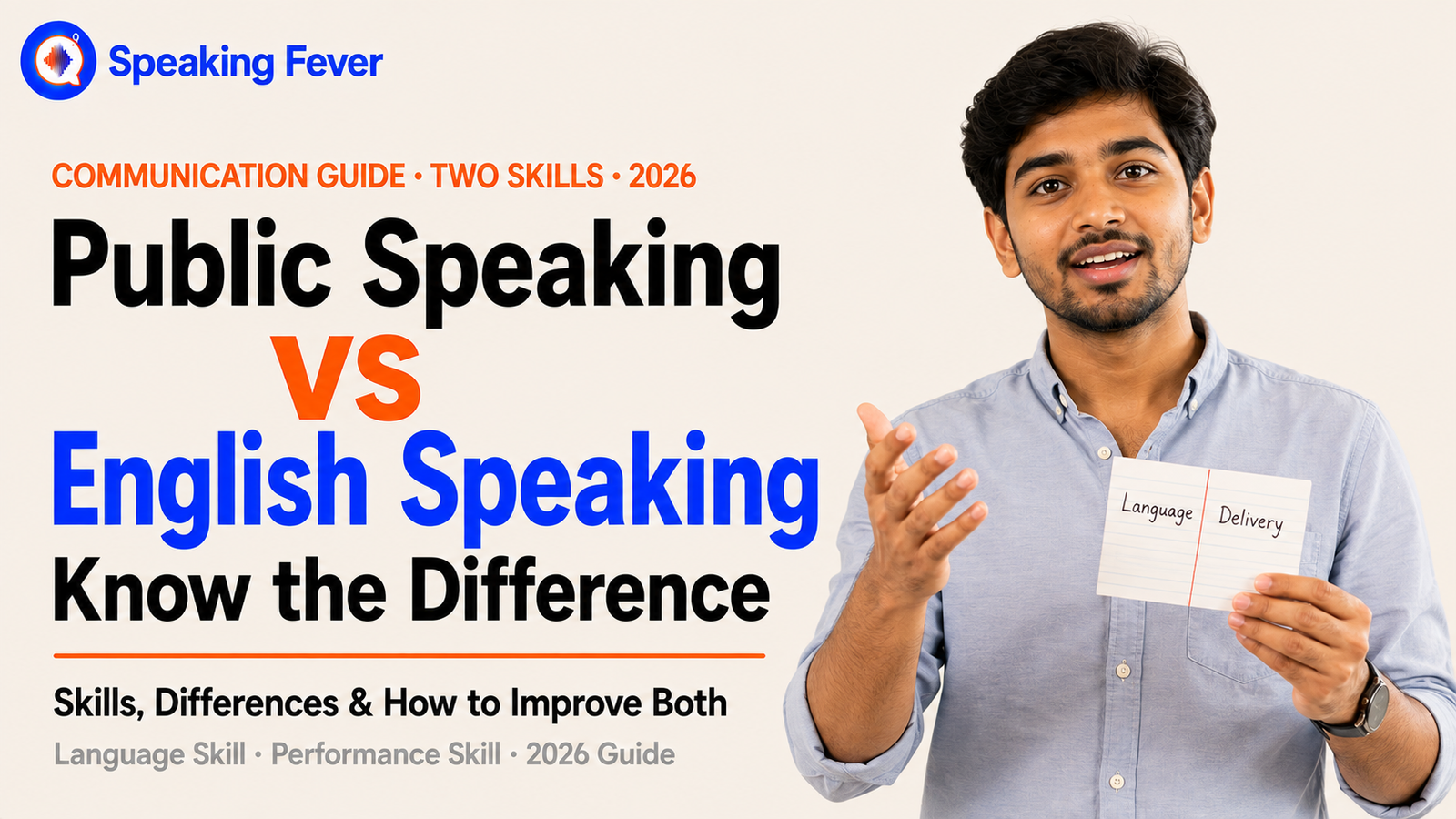
Ever wondered why some people speak great English but still freeze up on stage? Or why someone with a strong accent can still hold a room’s attention? That’s because “speaking well” is actually two different skills. We often mix them up – but they’re not the same thing at all.
In this guide, we’ll break down the real difference between public speaking and English speaking. We’ll also look at how they help each other, and how you can get better at both, whether you’re preparing for a job interview, a wedding speech, or your next big presentation at work.
Table of Contents

Public Speaking vs English Speaking: What’s the Difference?
Here’s the simplest way to think about it: English speaking is about the language. Public speaking is about how you deliver it.
English speaking is about using the right words, grammar, and pronunciation. Public speaking is about how you connect with an audience – your structure, your confidence, your body language, your tone. You can speak flawless English and still bomb a presentation. You can also have a thick accent and still be a fantastic speaker.
So one is a language skill. The other is a performance skill. They usually go hand in hand, but one doesn’t guarantee the other.
What Is English Speaking?
English speaking is your ability to share ideas clearly and correctly in English. It comes down to a few things:
- Vocabulary — knowing the right words to use
- Grammar — putting sentences together correctly
- Pronunciation — saying words clearly enough to be understood
- Fluency — talking smoothly, without long pauses or hesitation
- Listening — understanding what others say and responding quickly
This is what most people focus on in English classes or language apps. It’s the foundation – but it’s really about the mechanics of the language, not how you use it in front of people.
Being aware of the common English speaking mistakes Indians make with grammar, vocabulary, and pronunciation helps you fix the exact gaps that make English speaking feel unnatural.
What Is Public Speaking?
Public speaking is your ability to share a message with an audience in a way that’s clear, engaging, and convincing. It includes:
- Structure — organizing your ideas so they’re easy to follow
- Confidence — staying calm and sounding sure of yourself
- Body language — your posture, hand movements, and eye contact
- Voice — your tone, pace, volume, and pauses
- Reading the room — noticing how your audience feels and adjusting as you go
- Persuasion — making people actually care about what you’re saying
Public speaking is really a mix of mindset, performance, and communication strategy — and here’s the good part: you can build this skill in any language.
Public Speaking vs English Speaking: Key Differences
| Aspect | English Speaking | Public Speaking |
| Main focus | Correct, clear language | How you deliver your message |
| Key skills | Grammar, vocabulary, pronunciation | Structure, confidence, body language |
| Where you learn it | English classes, daily practice | Speech clubs, coaching, practice speeches |
| Can you have one without the other? | Yes — fluent speakers can still struggle on stage | Yes — great speakers exist in every language |
| Common fear | Making language mistakes | Being judged in front of people |
| How to improve | Read, listen, and talk more | Practice speeches and get feedback |
| How it’s judged | How correct and clear your English is | How well your message lands with people |
Are English Speaking and Public Speaking the Same?
Nope — they’re related, but they’re not the same. Think of English speaking as your toolkit: the words and grammar you have on hand. Public speaking is what you build with that toolkit once you’re standing in front of people. You need language to communicate at all, sure. But language alone won’t make your message powerful.
Can You Be Good at English but Bad at Public Speaking?
Definitely — and it happens more than you’d think. Plenty of people with perfect English still get nervous, lose their train of thought, or fail to hold an audience’s attention. That’s because fluency doesn’t teach you how to structure a talk, hold eye contact, manage your nerves, or read a room. Those are separate skills, and they have nothing to do with how “correct” your English is.

How English Speaking Skills Help With Public Speaking
Better English does make public speaking easier — here’s how:
- Less mental effort. You’re not searching for words, so you can focus on your delivery instead.
- Smoother pacing. Good fluency helps you sound confident instead of shaky.
- Better word choice. A wider vocabulary lets you land the exact tone you want — persuasive, warm, or authoritative.
- Faster recovery. If you lose your place, strong English skills help you find your way back quickly.
So basically, good English clears the path for you. It doesn’t build your performance skill on its own – but it makes everything else a lot easier.
Understanding how Indians think in English to speak fluently is what removes the mental effort of translation – so when you’re on stage, your brain is fully free to focus on delivery, eye contact, and connecting with your audience instead of searching for the right words.
How Public Speaking Skills Improve English Communication
This works the other way too, and it’s honestly one of the fastest ways to improve your English:
- Speaking under pressure builds real fluency faster than reading or studying ever could.
- Planning your talk helps you organize your sentences and ideas better, even in everyday conversation.
- Getting feedback on delivery often improves your pronunciation and word choice as a side effect.
- Repeating practice speeches helps you speak naturally, without overthinking every sentence.
A lot of people who join public speaking classes notice their everyday English improving too. Makes sense – you’re simply using the language more, and more often.
Joining spoken English classes for public speaking gives you a structured environment where both skills improve together – because every presentation session pushes you to use English more actively while building the confidence and delivery skills that make your message land.
Examples of English Speaking vs Public Speaking
- English speaking: Using “have been” and “had been” correctly.
- Public speaking: Pausing right before your most important line.
- English speaking: Pronouncing “entrepreneur” correctly.
- Public speaking: Making eye contact with different people around the room.
- English speaking: Building a strong professional vocabulary.
- Public speaking: Opening your talk with a short story instead of a slide full of text.
Building a strong habit of daily English speaking practice is the single most reliable way to make English feel natural – because your brain learns to form sentences directly in English instead of searching or translating every time.
How to Improve English Speaking Skills
- Talk every day — with friends, language partners, or an app.
- Listen often — podcasts, interviews, and shows help you pick up natural speech patterns.
- Read out loud — it builds pronunciation and fluency at the same time.
- Learn full phrases, not just words — real speech leans on common expressions, not isolated vocabulary.
- Record yourself — you’ll catch mistakes you’d never notice while actually speaking.
How to Improve Public Speaking Skills
- Join a speaking group — clubs like Toastmasters give you a low-pressure place to practice regularly.
- Speak out loud when you practice — don’t just run through your speech in your head.
- Plan your points before you write your script — nail your key ideas first, then worry about exact wording.
- Watch good speakers — pay attention to how they pause, move, and open or close a talk.
- Ask for feedback, then try again — real improvement comes from repeating and correcting, not doing it once and moving on.
A step-by-step guide to improve public speaking skills for beginners gives you practical exercises that take you from speaking to one person all the way to addressing larger audiences -so each stage feels manageable and confidence grows naturally.
How to Improve Both Skills Together
Here’s the fastest way to make progress: train both skills at the same time.
- Give speeches in English regularly — this builds fluency and delivery together.
- Join an English-speaking public speaking club so your feedback covers both language and delivery.
- Record and rewatch your speeches — check for grammar slips and delivery habits in the same session.
- Read famous speeches out loud — you’ll build vocabulary while practicing tone and pacing.
- Set two goals per practice session — for example, “use three new words” and “pause twice for effect.”
When you treat these as one combined practice instead of two separate to-dos, you’ll see progress much faster.
Common Mistakes to Avoid
- Assuming better English will fix your stage fear. It won’t — nerves come from delivery, not language.
- Memorizing your speech word-for-word. This often sounds stiff, and you’ll panic more if you forget a line.
- Ignoring your body language. Great words don’t count for much if you’re stiff and avoiding eye contact.
- Waiting for “perfect” English before you start speaking publicly. You build fluency by speaking, not by waiting around.
- Focusing only on content, not structure. Good ideas without a clear flow can still lose your audience.
The first mistake is one of the most common – and learning to speak English without fear or judgment is what helps you separate language anxiety from stage anxiety, so you can address both clearly instead of letting one hold back the other.
Which Skill Should You Learn First?
If English isn’t your first language, start by building basic fluency. You should be able to hold a normal conversation without translating every sentence in your head first. Trying to tackle public speaking while you’re still translating word by word just adds unnecessary pressure.
Once you’re comfortable speaking, start layering in public speaking practice. You don’t need “perfect” English to begin, just enough comfort that you can focus on your delivery instead of your vocabulary. From there, the two skills grow together, and it’s best to practice both side by side.
Want to Improve Both Your English and Public Speaking Skills?
Speaking Fever offers live 1-on-1 sessions where learners can practice English conversation, pronunciation, confidence, and public speaking with an expert trainer.
Reach us via
Book Your Slot with Our Counsellor:
Frequently Asked Questions
Is public speaking the same as English speaking?
No. English speaking is about using correct, fluent language. Public speaking is about how you deliver your message and connect with your audience.
Can I be fluent in English but still be a poor public speaker?
Yes. Fluency doesn’t teach you confidence, structure, or delivery — those are separate skills you need to practice on their own.
Does improving English improve public speaking?
It helps. It frees up mental energy so you can focus more on delivery. But it doesn’t replace real public speaking practice.
How can I improve my English speaking skills?
Talk every day, listen to native speakers, read out loud, and record yourself to track your progress.
How can I overcome fear of public speaking?
Start small. Practice in a low-pressure setting like a speaking club, prepare well, and focus on small improvements each time instead of aiming for perfect.
Which is more important, English speaking or public speaking?
Neither one wins -they do different jobs. English speaking helps you share your message. Public speaking makes that message actually land.
Can public speaking improve English fluency?
Yes. Speaking under pressure and planning your talks pushes you to use the language more actively, which often builds fluency faster than studying alone.
Written by: Dhanush T, Content/English Communication Specialist
Reviewed by: Aditi Pandey, Certified English Communication Trainer
“In spoken English training, learners often assume that hesitation means poor English. In practice, hesitation can also come from lack of speaking practice, anxiety, or difficulty organizing thoughts.”