

Key Takeaways:
- Stop translating: build short English sentences directly (“I am making tea”).
- Fix 4 grammar habits: verb position, articles, helping verbs and tense choice.
- Practise 4 sounds: v/w, th, z and “s” at the start of words (school, not “ischool”).
- Speak for 30 minutes a day: speaking practice matters more than grammar study.
- Keep your Indian accent: aim for clear speech, not a British or American accent.
If Hindi is your first language, you’re not alone in feeling that speaking English fluently is a challenge. Many learners from India struggle because their mind first thinks in Hindi and then translates into English. This slows them down, makes them nervous, and sometimes results in funny or incorrect sentences.
The good news? You can absolutely improve your spoken English with the right approach. Many Hindi speakers have already done it, and you can too.
You are in good company. In the 2011 Census, only about 10.6% of Indians reported speaking English as a first, second or third language (Census 2011 data), so most learners around you are working on the same skill.
In this blog, I’ll share some effective English learning tips for Hindi speakers, along with practical examples and resources that will help you become more confident in English, even if Hindi has been your first language since childhood.
Why Hindi Speakers Face Challenges in Spoken English
1. Mother Tongue Influence (MTI)
If you translate directly from Hindi, your sentences may sound broken. Example:
- Hindi: Main school ja raha hoon
- Word-for-word translation: I school going am.
- Common mistake: I going to school.
- Correct English: I am going to school.
This happens because Hindi puts the verb at the end of the sentence (subject-object-verb), while English puts it after the subject (subject-verb-object).
2. Pronunciation Hurdles
Some sounds in English don’t exist in Hindi. For example:
- V and W often get mixed up (wine vs vine).
- Th becomes a hard Hindi “थ” or “द” sound (three sounds like “tree”, and “the” sounds like “de”).
- Z often becomes j (zoo sounds like “joo”, and zero like “jero”).
- An extra “i” sound appears before “s” words (school sounds like “ischool”, station like “istation”).
Hindi speakers often hear English v and w as one sound, and Hindi has no exact match for the English “th” sounds. Many also say “j” for “z” and add an extra “i” before “s” words.
Speak English Confidently with live 1-on-1 online classes
- Learn from Expert English trainers
- Flexible timings for your schedule
- Budget-friendly course plans
3. Grammar Differences
Hindi uses different word order compared to English. For example, in Hindi we say:
- Woh khana kha raha hai → He food eating is.
But in English, it’s: He is eating food.
Hindi also has no articles like a, an and the, so many learners drop them: “He is doctor” instead of “He is a doctor.”
4. Confidence Barrier
Many learners hesitate to speak in English because they’re afraid of making mistakes or being judged.
Recommended course: Join Speaking Fever’s basic spoken English course for beginners, with expert trainers and flexible timings.
Common Hindi-to-English Mistakes (and How to Fix Them)
These tables show the habits that come from Hindi, the mistake they cause, and what to say instead.
Grammar and word order
| Hindi habit | Common mistake | Correct English |
| Verb at the end of the sentence | I school going am. | I am going to school. |
| No articles (a, an, the) | He is doctor. | He is a doctor. |
| Missing helping verb (is, am, are) | She very happy. | She is very happy. |
| Using “-ing” for everything | I am knowing him. | I know him. |
| Translating “ke baare mein” | We discussed about the plan. | We discussed the plan. |
Hindi tenses in English: a quick map
| Hindi | English pattern | Example |
| Main kha raha hoon | am / is / are + verb-ing | I am eating. |
| Main khata hoon | simple present | I eat. |
| Maine khaya | simple past | I ate. |
| Main kha chuka hoon | have / has + past participle | I have eaten. |
| Main kha raha tha | was / were + verb-ing | I was eating. |
| Main khaoonga | will + verb | I will eat. |
“Indian English” phrases and natural alternatives
Indian English is a real and valid variety of English. These alternatives simply help when you speak with people from other countries or in formal situations.
| You may hear | More natural alternative |
| Myself Rahul. | I’m Rahul. / My name is Rahul. |
| I am having two brothers. | I have two brothers. |
| Please do the needful. | Could you please take care of this? |
| Revert back to me. | Please reply to me. / Get back to me. |
| He is my cousin brother. | He is my cousin. |
| What is your good name? | What is your name? |
| Let’s prepone the meeting. | Let’s bring the meeting forward. |
For more help with sentences, read our guide on improving grammar while speaking.
Best Ways to Learn English for Hindi Speakers
1. Train Your Brain to Think in English
Stop translating in your head. Instead, practice forming simple English sentences directly. For example:
- Instead of thinking Main paani pee raha hoon → and then translating…
- Just think I am drinking water.
Start small with daily activities.
2. Master Pronunciation
Spend 5–10 minutes daily practicing difficult sounds.
- Record yourself saying words like very, world, thought, three.
- Compare your recording with clear speakers, for example on BBC Learning English. You do not need a British or American accent; aim to be clear.
Tip: Use YouTube pronunciation videos (like BBC Learning English) to train your ear.
3. Practice Speaking Daily
- Talk to your friends in English.
- Narrate your daily routine in English to yourself.
- Stand in front of a mirror and practice conversations.
Even 30 minutes a day makes a big difference.
If you are wondering how many days to learn spoken English this way, most beginners can hold short everyday conversations after about 60-90 days of daily practice (see the full timeline).
4. Learn Common English Phrases
Instead of memorizing grammar rules, pick useful phrases like:
- “Can you please help me?”
- “I’ll get back to you.”
- “What do you think about this?”
This makes you sound natural.To remember new phrases, use each one in your own sentence on the same day
5. Watch and Listen in English
Movies, shows, and podcasts are excellent tools. Watch with subtitles first, then without. Pick one character and copy their speaking style.
This matters for Indian learners: in the EF English Proficiency Index 2025, listening was India’s weakest English skill, with a score of 457.
6. Shadowing Technique
Listen to an English speaker and repeat exactly what they say, copying their tone and rhythm.
It may feel awkward at first, but this simple technique works wonders for fluency, especially when it comes to English learning for Hindi speakers who want to sound more natural and confident.
Recommended course: Practise with a trainer in Speaking Fever’s live 1-on-1 English speaking course for adults, with expert trainers and flexible timings.
A Simple 30-Day Practice Plan for Hindi Speakers
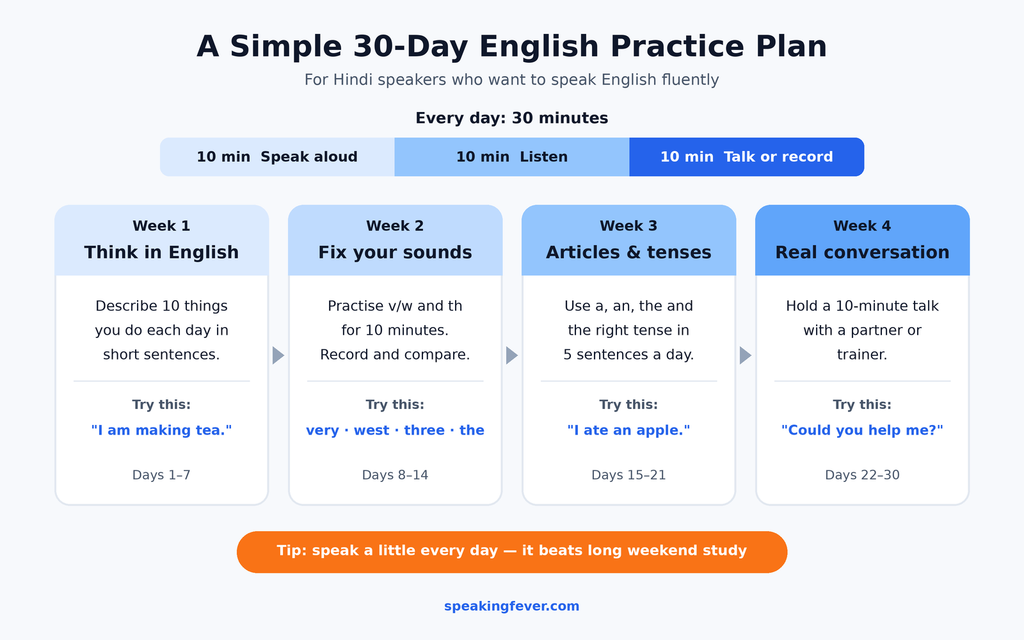
Spend about 30 minutes a day: 10 minutes speaking aloud, 10 minutes listening and 10 minutes of conversation or recording practice.
Building Confidence as a Hindi Speaker Learning English
- Start with short sentences: Don’t aim for perfection in the beginning. Even “I am fine,” “I am busy,” works.
- Don’t be afraid of mistakes: Every mistake is proof you’re learning.
- Record yourself: This helps you track progress and correct errors.
- Find a learning group: Join WhatsApp or Telegram groups for spoken English practice.
- Your Indian accent is not a problem: clear pronunciation matters more than sounding British or American.
Remember, confidence grows when you use English daily.
If speaking still makes you nervous, read how beginners can speak English without nervousness.
Conclusion
If Hindi is your first language, speaking English may feel tricky at first, but it’s completely possible to improve with the right methods. Focus on daily practice, pronunciation, and thinking in English instead of translating.
Every fluent English speaker once started as a learner, just like you. If they can do it, you can too. Stay consistent, stay confident, and you’ll see amazing progress in your spoken English journey.
Ready to start today? Book a trial class
Reach us via
Book Your Online English Trial Class
FAQs
1. Is Hindi a barrier to learning English?
No, Hindi is not a barrier. The only challenge is the habit of translating in your mind. With practice, you’ll learn to think in English directly.
2. Can I speak fluent English if I always think in Hindi?
Yes, but it will slow you down. The best way is to slowly shift your thinking to English—start with simple words and phrases, then move to full sentences.
3. What are the best spoken English tips for Hindi speakers?
- Think in English.
- Practice pronunciation.
- Speak every day, even to yourself.
- Learn phrases, not just grammar.
- 4. How long does it take to improve English fluency?
It depends on how much you speak. Many learners ask how many days to learn spoken English: with 30-35 minutes of daily speaking practice, most notice clear progress in 60-90 days and speak comfortably in 6-9 months.
5. Can watching movies really improve my English?
Absolutely! Movies help you pick up natural phrases, pronunciation, and real-life conversations.
6.How long does it take to learn English for beginners who speak Hindi?
About the same as other beginners: short everyday conversations in 2-3 months and comfortable speaking in 6-9 months with daily practice. If you studied in a Hindi-medium school, add 1-2 months to build basic vocabulary first.
7. Can I learn English through Hindi?
Yes. Books like Rapidex and the Spoken English Guru book explain English in Hindi, which helps at the start. To start speaking, choose an English speaking course where a trainer makes you speak and corrects you.
8. How do I stop translating from Hindi in my head?
Start with things you do every day. Describe them in short English sentences, like “I am making tea”, without thinking of the Hindi first. Do this for 5-10 minutes daily, and it gets easier within a few weeks.