


Key Highlights
- Speaking naturally is more important than copying a perfect accent.
- Improve your listening before expecting better speaking.
- Practice shadowing to develop natural rhythm and pronunciation.
- Learn phrases instead of memorizing individual words.
- Think directly in English whenever possible.
Many English learners dream of being able to speak English like a native speaker, but that doesn’t mean copying an American or British accent perfectly. The real goal is to speak naturally, communicate clearly, and feel confident in everyday conversations. Whether you’re practicing on your own or taking a one-to-one English speaking course, building the right habits can help you become a fluent and confident speaker.
According to the British Council’s guide, “Seven Simple Ways to Improve Your Speaking Skills,” regular speaking practice, active listening, and using English in real-life situations are some of the most effective ways to improve your fluency. The guide also recommends making English a part of your daily routine instead of practicing only occasionally.
In this guide, you’ll learn seven practical techniques that can help you speak more naturally. We’ll cover pronunciation, listening, vocabulary, conversation practice, and simple daily habits that make a real difference over time.
Table of Contents
What You’ll Learn
Learning to sound natural is about much more than learning new words. You’ll need to improve the way you listen, speak, and think in English.
In this guide, you’ll learn:
- What makes native speakers sound natural?
- How to improve your pronunciation and fluency.
- The importance of listening before speaking.
- Practical techniques you can use every day.
- Common mistakes that stop learners from improving.
- A simple routine to build long-term speaking confidence.
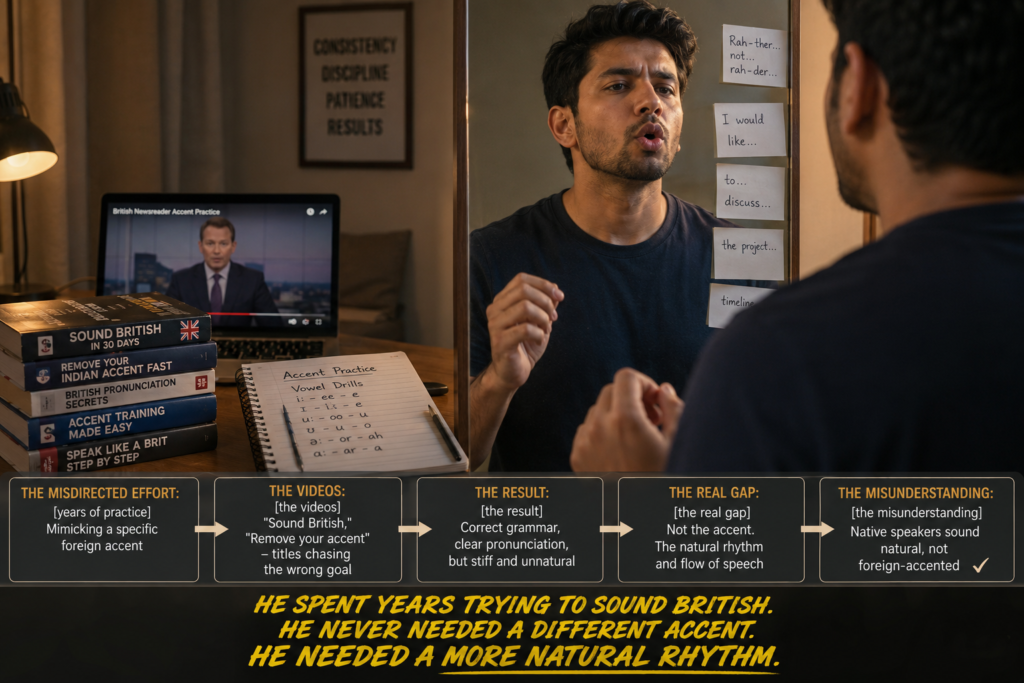
What Does It Really Mean to Speak Like a Native Speaker?
Many learners believe they need a perfect foreign accent to sound like a native speaker. In reality, that’s one of the biggest misconceptions. Native speakers don’t sound natural because of their accent alone-they sound natural because they speak smoothly, use everyday expressions, and communicate without translating every sentence in their minds.
Think about conversations in your own language. You don’t stop to think about grammar before every sentence. You simply speak. That’s exactly how fluent English works. As your confidence grows, you’ll spend less time thinking about rules and more time expressing your ideas naturally.
Instead of chasing a perfect accent, focus on building these skills:
- Speak clearly instead of speaking quickly.
- Learn useful everyday English phrases.
- Build your vocabulary through real conversations.
- Improve your pronunciation one sound at a time.
- Practice speaking regularly to develop confidence.
When you focus on communication instead of perfection, you’ll notice steady improvement in your spoken English and overall communication skills.
1. Listen to Native Speakers Every Day
If you want to speak English fluently, you first need to train your ears. Knowing how to improve English listening skills is the foundation – because listening helps your brain become familiar with the rhythm, flow, and natural patterns of English that textbooks simply cannot teach.
Many learners spend hours studying grammar but very little time listening to real English. As a result, they know the language but struggle to understand conversations or respond naturally. Daily listening practice helps your brain become familiar with the rhythm and flow of English.
What should you listen to?
Choose content that matches your current English level. Don’t start with very difficult movies or fast news channels if you’re a beginner.
Good options include:
- English podcasts for learners.
- YouTube videos with subtitles.
- Interviews with native speakers.
- English TV shows and documentaries.
- Audiobooks with transcripts.
What should you pay attention to?
Don’t just listen to understand the meaning. Observe how people speak.
Notice things like:
- English intonation (how the voice rises and falls).
- English rhythm (the natural flow of speech).
- Stress and pronunciation of important words.
- How words connect together in fast conversations.
- Common pauses and speaking patterns.
Over time, you’ll begin to recognize these patterns automatically, making it much easier to understand and respond in conversations.

2. Practice the Shadowing Technique
One of the fastest ways to improve English speaking skills is by using the shadowing technique. Language learners and trainers around the world use this method because it helps you improve pronunciation, fluency, and confidence at the same time.
Shadowing is simple. You listen to a native speaker and repeat what they say almost immediately, trying to copy not just the words but also the rhythm, speed, and pronunciation. This trains your mouth to produce English sounds more naturally.
At first, it may feel difficult. That’s completely normal. Start with short audio clips and focus on accuracy instead of speed. As you continue practicing, your speech will become smoother and you’ll begin to sound more natural without thinking too much.
How to practice shadowing
- Choose a short audio clip (30–60 seconds).
- Listen once without speaking.
- Play it again and repeat immediately.
- Record your voice and compare it with the original.
- Practice the same clip for several days before choosing a new one.
Example
Imagine the speaker says:
“I’m going to grab a coffee before work.”
A beginner might pronounce every word separately.
A native speaker naturally connects the words, making the sentence sound smoother. Learning this type of connected speech helps you sound more natural without forcing a different accent.
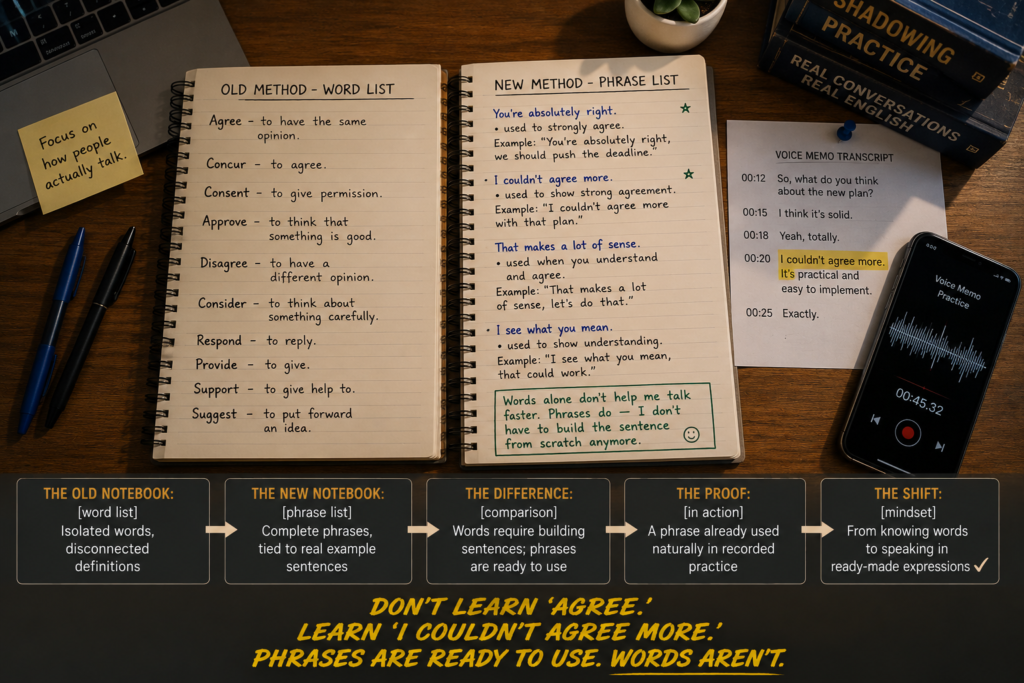
3. Learn Phrases, Not Just Individual Words
Many learners spend months memorizing vocabulary but still struggle during conversations. The reason is simple – native speakers usually think and speak in phrases, not isolated words.
Taking time to improve English vocabulary and speaking skills through phrases and real-life expressions helps your conversations sound natural and helps you respond quickly without building every sentence from scratch.
For example, knowing the word “agree” is useful, but learning expressions like “You’re absolutely right” or “I couldn’t agree more” helps your conversations sound much more natural. This also improves your ability to respond quickly because you’re recalling complete expressions instead of building every sentence from scratch.
When learning new vocabulary, try to learn it in context. Read articles, watch conversations, and notice how words are actually used together.
Some useful habits include:
- Learn 5–10 everyday English phrases each week.
- Write your own example sentence for each phrase.
- Use new expressions in daily conversations.
- Review old phrases regularly instead of only learning new ones.
This approach helps you learn to speak English naturally while building stronger English vocabulary that you can actually use in real conversations.
4. Improve Your Pronunciation, Not Your Accent
Many learners believe they need an American or British accent to sound like a native speaker. The truth is that clear pronunciation is much more important than having a perfect accent. If people understand you easily, you’re already communicating successfully.
Native speakers around the world have different accents, but they all focus on speaking clearly. That’s why your goal should be to pronounce words correctly, stress the right syllables, and speak at a comfortable pace instead of trying to imitate someone else’s voice.
Good pronunciation also improves your confidence because you won’t need to repeat yourself during conversations.
Simple ways to improve your pronunciation
- Read aloud for 10–15 minutes every day.
- Listen carefully to how words are pronounced.
- Practice difficult sounds one at a time.
- Record yourself and compare your speech.
- Speak slowly instead of rushing.
Focus on these areas
Instead of trying to fix everything at once, improve these skills gradually:
- Stress and pronunciation of important words.
- Natural pauses between sentences.
- Clear vowel and consonant sounds.
- Smooth word connections during conversations.
- Speaking at a steady pace.
Remember, people remember good communication-not a perfect accent.

5. Think in English Instead of Translating
One of the biggest reasons learners hesitate while speaking is because they first think in their native language and then translate everything into English.
The most effective way to fix this permanently is to think in English to speak fluently – starting with small daily thoughts and gradually building to full conversations without any translation in between.
Native speakers don’t translate-they think directly in English. You can build this habit gradually by using English for small everyday thoughts instead of waiting until you start a conversation.
For example, when you’re making tea, think:
“The water is boiling.”
Instead of translating from your native language.
When you’re walking outside, describe what you see in English. These small exercises train your brain to respond naturally.
Daily activities to help you think in English
- Describe your surroundings.
- Plan your day in English.
- Name objects around your house.
- Think about tomorrow’s schedule in English.
- Ask yourself simple questions and answer them.
The more you practice, the less you’ll depend on translation, and your natural English speaking ability will improve.
6. Practice Real Conversations, Not Perfect Sentences
Many learners spend hours memorizing grammar rules but rarely speak. Speaking is a practical skill, and like any other skill, it improves only through regular practice.
Building strong English conversation practice online through live sessions gives you the real speaking pressure, immediate feedback, and natural dialogue that self-study simply cannot replicate.
Instead of trying to create perfect sentences every time, focus on communicating your ideas. Small mistakes are a normal part of learning, and every conversation helps you become more fluent.
One of the best ways to improve is by speaking with someone who can guide you and correct your mistakes. If you’re looking for structured speaking practice, an Advanced English Speaking Course can provide regular conversations, personalized feedback, and activities that help you become more confident in real-life situations.
Ways to practice conversations
- Speak with friends in English.
- Join online conversation groups.
- Practice role plays for everyday situations.
- Answer common speaking questions aloud.
- Record short one-minute conversations.
Real-life situations you can practice
Try speaking about topics you use every day, such as:
- Introducing yourself.
- Ordering food.
- Talking about your hobbies.
- Asking for directions.
- Discussing your work or studies.
Practicing real situations prepares you for everyday conversations much better than memorizing textbook dialogues.
7. Build a Daily Speaking Routine
Improving your English doesn’t require studying for five hours every day. What matters most is consistency. A focused daily English speaking practice routine of even 20–30 minutes every day produces far better results than several hours of study once a week – because it keeps English active in your brain and builds long-term fluency steadily.
A daily routine helps you improve all the important areas together, including pronunciation, vocabulary, listening, and speaking confidence.
Here’s a simple routine you can follow.
| Activity | Time |
| Listen to English audio | 10 minutes |
| Read aloud | 10 minutes |
| Learn new phrases | 5 minutes |
| Speak about one topic | 10 minutes |
| Review mistakes | 5 minutes |
Following a routine like this keeps English a part of your everyday life and gradually builds long-term English fluency.
Common Mistakes That Stop You From Sounding Natural
Many learners work hard but unknowingly repeat habits that slow down their progress. Recognizing these mistakes early can help you improve much faster.
Some common mistakes include:
- Translating every sentence before speaking.
- Speaking too fast because of nervousness.
- Memorizing conversations instead of understanding them.
- Ignoring listening practice.
- Learning difficult words you never use.
- Being afraid of making mistakes.
- Practicing only occasionally instead of every day.
Don’t worry if you’ve made some of these mistakes before. The important thing is to notice them and gradually replace them with better habits.
A Simple 30-Day Plan to Sound More Natural
Learning to speak naturally doesn’t happen overnight. It comes from doing small things consistently. Instead of trying to improve everything at once, focus on building a simple daily routine that strengthens your listening, speaking, pronunciation, and vocabulary together.
The goal isn’t to study for hours every day. The goal is to make English part of your daily life. When you practice a little every day, your brain starts thinking in English more naturally, and speaking becomes easier.
Here’s a simple routine you can follow.
| Daily Activity | Time |
| Listen to English podcasts or videos | 10 minutes |
| Practice shadowing | 10 minutes |
| Learn 5 new phrases | 5 minutes |
| Speak about one topic | 10 minutes |
| Review and correct mistakes | 5 minutes |
If you stay consistent for just one month, you’ll notice better pronunciation, stronger vocabulary, and much greater speaking confidence.
Common Mistakes That Stop You From Sounding Like a Native Speaker
Many learners believe they’re improving because they study grammar every day. However, speaking is a practical skill, and it only develops through regular communication. Sometimes, small habits slow your progress without you realizing it.
The good news is that these mistakes are easy to fix once you become aware of them.
Mistake 1: Focusing Too Much on Grammar
Grammar is important, but stopping to think about every rule makes conversations slow and unnatural.
Instead:
- Learn grammar through conversations.
- Notice how native speakers form sentences.
- Focus on expressing ideas clearly.
Mistake 2: Being Afraid of Making Mistakes
Many learners stay silent because they worry about speaking incorrectly. In reality, mistakes are a normal part of learning any language.
Remember:
- Every mistake teaches you something new.
- Confidence grows through practice.
- Speaking regularly is more important than speaking perfectly.
Mistake 3: Memorizing Instead of Communicating
Memorized answers work only in predictable situations. Real conversations change quickly, so you need to learn how to think and respond naturally.
Practice by:
- Talking about your daily life.
- Sharing your opinions.
- Asking simple questions.
- Joining real conversations whenever possible.
Mistake 4: Ignoring Listening Practice
If you don’t hear natural English regularly, it’s difficult to develop natural speech yourself.
Spend time listening to:
- Podcasts
- Interviews
- Movies
- TED Talks
- YouTube conversations
The better you listen, the more naturally you’ll begin to speak.
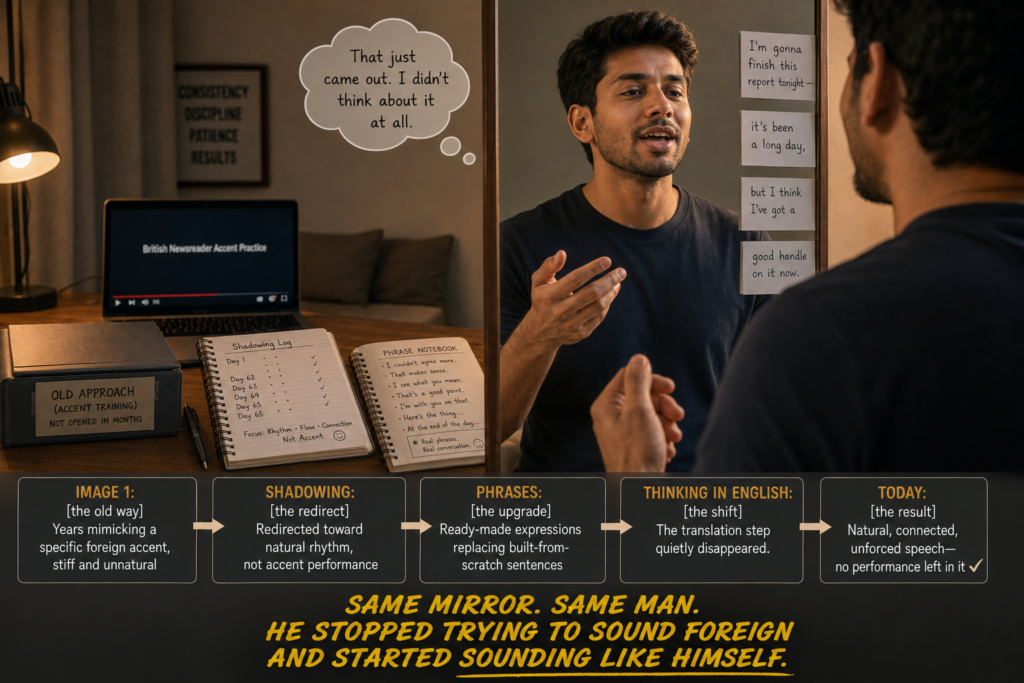
Signs Your English Is Becoming More Natural
Many learners expect dramatic improvements overnight. In reality, progress happens little by little. Small changes are often the best signs that your speaking skills are improving.
You may notice that you:
- Speak without translating every sentence.
- Understand conversations more easily.
- Use everyday expressions naturally.
- Pause less while speaking.
- Feel more confident during conversations.
- Remember vocabulary without memorizing it.
- Enjoy speaking instead of avoiding it.
These are clear signs that you’re developing real English fluency, not just learning grammar rules.
Conclusion
If you want to speak English like a native speaker, remember that fluency comes from daily practice, not from trying to sound perfect. Focus on speaking clearly, listening carefully, and using English in real-life situations whenever you can. Small improvements every day will help you become a more natural and confident speaker over time.
Don’t worry if you make mistakes in the beginning. Every conversation helps you improve your pronunciation, vocabulary, and speaking confidence. Stay consistent, enjoy the learning process, and celebrate every small step forward.
If you’d like extra support, a structured program like Speaking Fever’s Courses can give you regular speaking practice, personalized feedback, and real conversations to help you build confidence and communicate more naturally.
Reach us via
Book Your Slot with Our Counsellor:
Frequently Asked Questions (FAQ)
1. How Can I Speak English Like a Native Speaker?
The best way to speak English like a native speaker is to practice every day, listen to real conversations, improve your pronunciation, and learn common English phrases instead of memorizing individual words. Consistency is more important than perfection.
2. Do I Need a Native English Accent to Sound Natural?
No. You don’t need an American or British accent to communicate well. Clear pronunciation, natural sentence flow, and confidence matter much more than sounding exactly like a native speaker.
3. What Is the Fastest Way to Improve My English Speaking Skills?
Practice speaking daily, use the shadowing technique, listen to English podcasts or videos, and have real conversations whenever possible. These habits help you improve your fluency much faster than studying grammar alone.
4. How Long Does It Take to Speak English Fluently?
The timeline depends on your current level, how often you practice, and your learning method. With consistent daily practice, many learners notice better fluency and confidence within a few months.
5. Why Do I Translate Every Sentence Before Speaking?
This usually happens because your brain is still thinking in your native language. Practicing simple daily thoughts in English and speaking regularly can help you develop the habit of thinking directly in English over time.
6. What Are the Biggest Mistakes That Stop English Fluency?
Some common mistakes include focusing only on grammar, memorizing answers, avoiding conversations because of fear, and not listening to enough real English. Speaking regularly and learning from mistakes will help you improve much faster.
7. Can I Learn to Speak Naturally Without Living Abroad?
Yes. Many learners become fluent without moving to an English-speaking country. Watching English content, practicing with speaking partners, and using English in your daily routine can help you develop natural communication skills from anywhere.
8. How Can I Practice Speaking English Every Day?
Create a simple daily routine that includes listening, reading aloud, learning new phrases, and speaking about everyday topics. If you want more structured guidance, a one-on-one program like Speaking Fever can provide regular speaking practice and personalized feedback to help you become a more confident English speaker.