
Top 8 Grammar Mistakes English Learners Make (And How to Fix Them Fast)


Key Highlights
- Learn one grammar rule at a time.
- Practice speaking every day.
- Read simple English articles regularly.
- Focus on clear communication, not perfection.
- Correct your mistakes instead of fearing them.
- Build confidence through consistent practice.
- Small daily improvements lead to better English.
Table of Contents
Many English learners know plenty of words but still make small grammar mistakes while speaking or writing. If you’re searching for Common grammar mistakes in English, you’re not alone because these mistakes are a normal part of learning. The good news is that once you understand them, they become much easier to fix.
According to Cambridge Dictionary’s English Grammar Today, learning grammar patterns and using them in everyday conversations helps learners communicate more clearly and confidently. If you’re looking for a Personalized English Speaking Course, practicing with expert guidance can help you improve faster and avoid repeating the same mistakes.
In this guide, you’ll learn the eight Grammar mistakes English learners make, understand why they happen, and discover simple ways to correct them quickly. Whether you’re preparing for school, work, these practical ideas will help you speak with more confidence.
What You’ll Learn
Good grammar helps people understand your message without confusion. You don’t need to memorize every grammar rule, but you should know the most common mistakes and how to avoid them.
In this guide, you’ll learn:
- The Most common grammar mistakes beginners make.
- Simple ways to Improve English grammar every day.
- Easy English grammar tips you can use while speaking.
- Practical examples that are easy to remember.
- Small habits that make a big difference over time.
By the end of this article, you’ll feel more confident using English in daily conversations.

Why Grammar Matters When You Speak English
Many people think grammar only matters in writing. That’s not true. Good grammar also helps you speak clearly and makes your ideas easier to understand.
You don’t need perfect grammar to speak English confidently. But avoiding Common English grammar errors makes your conversations smoother, especially during meetings, presentations, and interviews.
Good grammar can help you:
- Speak with confidence.
- Avoid misunderstandings.
- Sounds more professional.
- Express your ideas clearly.
- Build better communication skills.
Even small improvements can make your English sound much more natural.
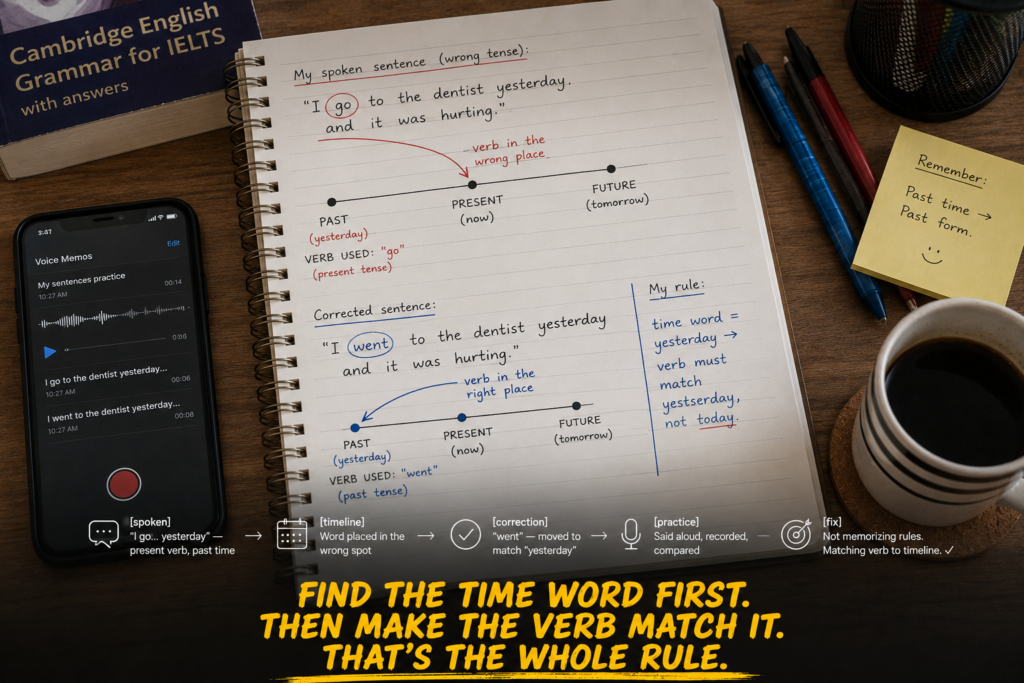
Mistake #1: Using the Wrong Verb Tense
One of the biggest English grammar mistakes beginners make is using the wrong verb tense. Many learners switch between the past, present, and future without realizing it. This can confuse the listener because the time of the action becomes unclear.
Instead of trying to remember every grammar rule, focus on understanding when an action happened. Once you know the time, choosing the correct tense becomes much easier.
Here are some common examples:
| Incorrect | Correct |
| I go to school yesterday. | I went to school yesterday. |
| She eat breakfast every day. | She eats breakfast every day. |
| They was happy. | They were happy. |
To improve:
- Notice time words like yesterday, today, and tomorrow.
- Practice one tense at a time.
- Read simple English stories every day.
- Speak short sentences using the correct tense.
Regular practice is one of the easiest ways to fix grammar mistakes in English without feeling overwhelmed.
If you want to identify more everyday speaking errors, explore our guide on common mistakes Indians make while speaking English to understand the patterns that affect fluency and accuracy.
Mistake #2: Forgetting Articles (A, An, and The)
Articles may look like tiny words, but they make a big difference. Many learners skip them because some languages don’t use articles in the same way English does.
Learning when to use a, an, and the will make your sentences sound much more natural.
Remember these simple rules:
- Use a before words that begin with a consonant sound.
- I bought a book.
- Use an before words that begin with a vowel sound.
- She is an engineer.
- Use the when talking about something specific.
- The teacher is waiting.
Don’t worry if you forget sometimes. The more you read and listen to English, the easier articles become.
Learning how to use articles in spoken English with real-life examples makes it easier to use a, an, and the naturally during conversations.
Mistake #3: Subject and Verb Don’t Match
Another one of the Grammar mistakes English learners make is forgetting that the subject and verb should agree. In simple words, a singular subject needs a singular verb, and a plural subject needs a plural verb.
This mistake often happens when learners speak quickly. Slowing down for a second before answering can help you choose the correct verb naturally.
Look at these examples:
| Incorrect | Correct |
| He go to work every day. | He goes to work every day. |
| My friends likes football. | My friends like football. |
| The dog bark every night. | The dog barks every night. |
Here are a few simple English grammar for beginners tips:
- Find the subject first.
- Check if it is singular or plural.
- Match the verb with the subject.
- Read your sentence aloud to hear if it sounds correct.
Mastering subject-verb agreement also helps reduce English speaking grammar mistakes, making your conversations smoother and easier to understand.
Mistake #4: Using the Wrong Preposition
Prepositions are small words like in, on, at, for, and to, but they can completely change the meaning of a sentence. Many learners use the wrong preposition because they translate directly from their native language.
The best way to learn prepositions is by seeing them in real conversations instead of trying to memorize long grammar rules.
Here are some common examples:
| Incorrect | Correct |
| She is good in English. | She is good at English. |
| I will meet you in Monday. | I will meet you on Monday. |
| He arrived to the airport. | He arrived at the airport. |
To improve your prepositions:
- Learn them as complete phrases instead of single words.
- Read English articles and notice how prepositions are used.
- Keep a notebook of new expressions.
- Practice speaking those expressions every day.
Small corrections like these help you avoid Common English grammar errors and make your English sound much more natural.
You can also learn how to improve grammar and sentence structure in speaking to fix prepositions and other sentence-level mistakes more effectively.
Mistake #5: Confusing “Your” and “You’re”
Many English learners know these words, but they still mix them up while writing. Since they sound the same, it’s easy to choose the wrong one if you’re writing quickly.
The trick is simple. If you know what each word means, you’ll rarely make this mistake again.
Remember:
- Your shows ownership.
- Your phone is ringing.
- You’re means you are.
- You’re doing a great job.
A quick tip is to replace you’re with you are. If the sentence still makes sense, you’ve chosen the correct word.
For example:
- You’re my best friend.
- You are my best friend.
Both sentences mean the same thing, so you’re correct.
This is one of the most common grammar mistakes because many people type too fast without checking their sentences.
Mistake #6: Using Double Negatives
A double negative happens when two negative words appear in the same sentence. In English, this usually creates an incorrect sentence or changes the meaning.
Many learners make this mistake while translating from another language. Once you understand the pattern, it’s easy to avoid.
Examples include:
| Incorrect | Correct |
| I don’t know nothing. | I don’t know anything. |
| She didn’t say nobody. | She didn’t say anybody. |
| We don’t need no help. | We don’t need any help. |
Keep these ideas in mind:
- Use only one negative word in a sentence.
- Read your sentence again before speaking.
- Replace nothing, nobody, or no with anything, anybody, or any when needed.
Correcting double negatives is a simple step to improve English grammar and make your communication clearer.
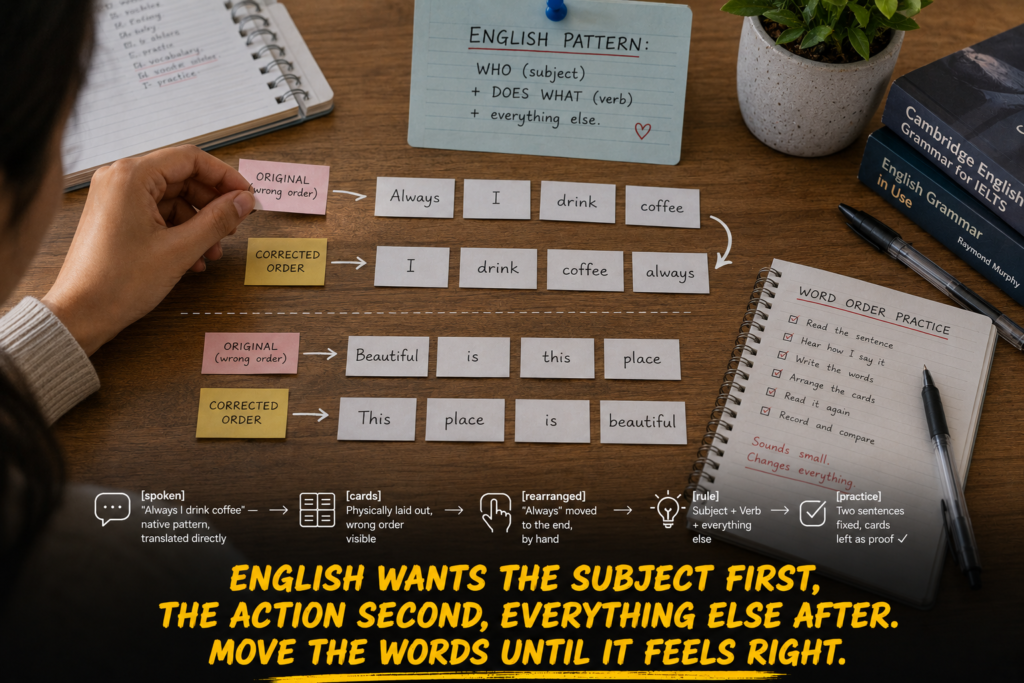
Mistake #7: Putting Words in the Wrong Order
English follows a fairly simple sentence pattern. Most sentences use Subject + Verb + Object. When learners translate directly from another language, the word order often changes, making the sentence sound unnatural.
Instead of translating every sentence, try thinking in English. This helps you naturally follow the correct sentence structure.
Compare these examples:
| Incorrect | Correct |
| Always I drink coffee. | I always drink coffee. |
| Beautiful is this place. | This place is beautiful. |
| Quickly he finished the work. | He finished the work quickly. |
To avoid this mistake:
- Practice short sentences first.
- Read simple English books aloud.
- Listen to native speakers.
- Repeat sentences exactly as you hear them.
Learning the correct word order is one of the easiest English grammar tips for building confidence while speaking.
Learning how Indians think in English to speak fluently can help you stop translating word for word and build more natural sentence patterns.
Mistake #8: Using the Wrong Pronouns
Pronouns replace nouns and make sentences shorter and easier to understand. Words like he, she, they, him, her, and them are used every day, but many beginners still confuse them.
This usually happens when learners speak quickly or translate directly from another language.
Here are a few examples:
| Incorrect | Correct |
| Me and my friend went shopping. | My friend and I went shopping. |
| Him is my brother. | He is my brother. |
| Give the book to she. | Give the book to her. |
A simple way to improve is to notice how pronouns are used in books, movies, and conversations. The more examples you see, the easier they become.
If you’re just starting your learning journey, a 1-on-1 Beginner English Speaking Course gives you the chance to practice these grammar rules during real conversations. Regular speaking practice with personal feedback helps you correct mistakes naturally instead of simply memorizing grammar rules.
Simple Daily Habits to Improve Your Grammar
Learning grammar doesn’t have to be difficult. Small daily habits can help you improve much faster than studying grammar only once in a while.
Instead of trying to learn everything at once, focus on one grammar point each day and use it while speaking or writing. Over time, these small improvements become natural habits.
Here are a few simple ideas you can start today:
- Read an English article for 10 minutes every day.
- Write five simple English sentences.
- Listen to English podcasts or short videos.
- Record yourself speaking and listen again.
- Learn one grammar rule and use it in conversations.
- Read your messages before sending them.
- Keep a notebook of new grammar patterns you learn.
These habits not only help you avoid English speaking grammar mistakes, but they also make it much easier to fix grammar mistakes in English through regular practice instead of memorization.
Following a routine of daily English speaking practice helps reinforce grammar rules through real conversations and consistent repetition.
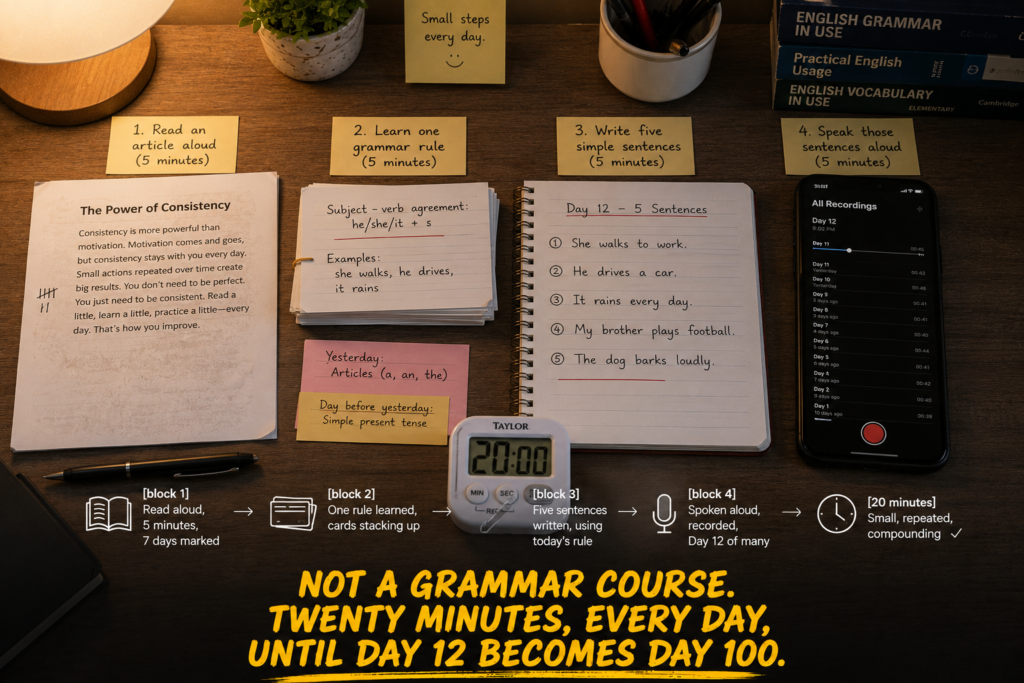
Daily 20-Minute Grammar Practice Routine
You don’t need to spend hours studying grammar every day. Just 20 minutes of focused practice can help you avoid many common grammar mistakes in English and build your confidence while speaking. The secret is to practice a little every day instead of trying to learn everything at once.
Here’s a simple routine you can follow:
| Activity | Time |
| Read an English article aloud | 5 minutes |
| Learn one grammar rule | 5 minutes |
| Write five simple sentences | 5 minutes |
| Speak those sentences aloud | 5 minutes |
Following this routine every day will help you notice fewer mistakes and make grammar feel more natural.

How to Avoid Grammar Mistakes While Speaking
Many learners know grammar rules but forget them while speaking because they focus on speaking quickly. The best way to avoid mistakes is to slow down, think for a moment, and speak simple sentences.
Remember, confidence comes from practice, not from being perfect. Every conversation is an opportunity to improve your English naturally.
Here are a few simple habits that can help:
- Think in English instead of translating.
- Use short and simple sentences.
- Speak a little slower.
- Listen carefully to fluent English speakers.
- Read your sentences aloud whenever possible.
- Learn from your mistakes instead of worrying about them.
- Practice speaking every single day.
The more you use English in real conversations, the easier it becomes to speak correctly without thinking too much about grammar rules.
Why Small Grammar Improvements Make a Big Difference
Many learners feel discouraged when they make grammar mistakes. The truth is that even fluent English speakers make mistakes sometimes. What matters most is your willingness to learn and improve every day.
Instead of trying to master every grammar rule at once, focus on correcting one mistake at a time. As you continue practicing, you’ll notice that your confidence grows along with your speaking skills.
Good grammar also helps you in many real-life situations, such as:
- School and college assignments.
- Job interviews and workplace communication.
- Business emails and presentations.
- Public speaking and group discussions.
- Everyday conversations with friends and colleagues.
When your grammar improves, people understand your ideas more easily, and you feel more comfortable expressing yourself.
Conclusion
Learning grammar doesn’t have to be difficult. Once you understand these Common grammar mistakes in English, you’ll find it much easier to speak and write with confidence. The key is to practice regularly, use simple sentences, and learn from every mistake you make.
Remember that everyone makes mistakes while learning a new language. Instead of worrying about being perfect, focus on improving a little every day. Over time, you’ll notice stronger communication skills, better sentence formation, and greater confidence in both speaking and writing.
If you’re looking for personal guidance, Speaking Fever offers one-to-one English speaking classes designed to help beginners improve grammar, build confidence, and become fluent through real conversations and practical learning. With regular practice and the right support, you can achieve your English-speaking goals faster than you think.
Reach us via
Book Your Slot with Our Counsellor:
Frequently Asked Questions (FAQs)
1. What Are the Most Common Grammar Mistakes in English?
Some of the most common grammar mistakes in English include using the wrong verb tense, forgetting articles (a, an, the), incorrect prepositions, subject-verb agreement errors, and confusing words like your and you’re. Learning these basics can make your English much clearer and more natural.
2. How Can I Fix Grammar Mistakes in English Quickly?
The best way to fix grammar mistakes in English is to practice one grammar rule at a time. Read English every day, write short sentences, and speak them aloud to build confidence and remember the correct patterns.
3. How Can I Improve My English Grammar Every Day?
You can improve English grammar by reading English books or articles, listening to English conversations, writing a few sentences daily, and reviewing your mistakes. Even 20 minutes of daily practice can help you make steady progress.
4. Why Do English Learners Make Grammar Mistakes?
Many grammar mistakes English learners make happen because they translate directly from their native language or don’t practice enough. Regular speaking, reading, and listening help you understand how grammar is used naturally in everyday English.
5. Is Good Grammar Important for Speaking English Confidently?
Yes. Good grammar helps you express your ideas clearly and makes it easier for others to understand you. While you don’t need perfect grammar, avoiding common English grammar errors can improve your confidence in conversations, meetings, and interviews.
6. What Are the Best English Grammar Tips for Beginners?
Start with simple grammar rules instead of trying to learn everything at once. Focus on verb tenses, subject-verb agreement, articles, and sentence structure, then practice using them in daily conversations to build a strong foundation.
7. How Can Grammar Help Me Perform Better in Job Interviews?
Using correct grammar helps you answer interview questions more clearly and professionally. Along with following English speaking tips for interviews, improving your grammar can help you make a positive first impression and communicate your skills with confidence.
8. Which Is the Best Way to Learn English Grammar for Beginners?
The best way to learn English grammar for beginners is through regular speaking practice, simple grammar lessons, and personalized feedback. Speaking Fever’s one-to-one English speaking classes help learners understand grammar naturally, correct mistakes in real conversations, and build confidence faster.