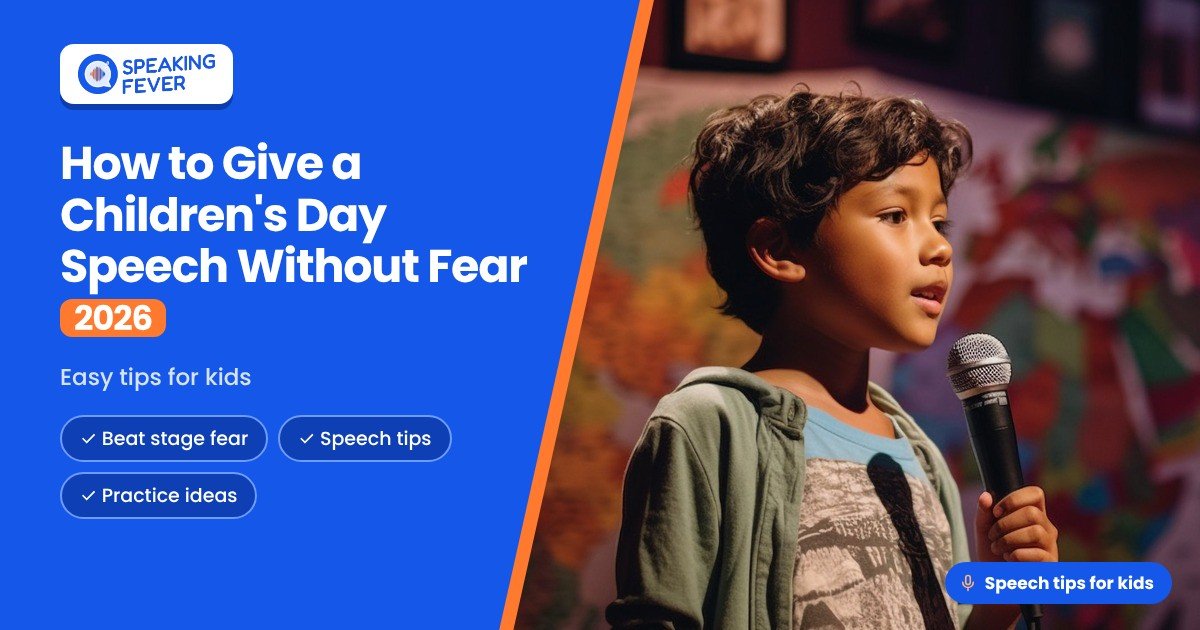
How to Give a Children’s Day Speech Without Fear: Tips for Kids (2026)

Key Takeaways:
A child can give a confident Children’s Day speech by keeping it short, practising it out loud every day for a week, and learning a few simple ways to calm stage fear. Here is what works best:
- Keep it short: a 1 minute Children’s Day speech is about 100–120 words when spoken slowly, which is enough for most young children.
- Use a simple structure: greeting, why we celebrate Children’s Day on 14 November, one personal message, and a thank-you.
- Practise in stages: read it, then speak from keywords, then practise in front of family.
- Calm the nerves: take slow breaths, smile at a friendly face, and call the nervous feeling “excitement”.
- On the day: sip water, keep the cue card close, and take three slow breaths before going on stage.
- Don’t aim for perfect: if your child forgets a line, a short pause and a look at the cue card is completely fine.
For parents: praise effort, not perfection. A child who feels safe making mistakes speaks with much more confidence.
Introduction
For many children, the Children’s Day assembly is their first time speaking on a stage. Most sample speeches online give children the words, but not the confidence to say them. This guide covers both: a simple way to prepare a Children’s Day speech for kids, practical tips to beat stage fear, and short sample speeches your child can use and change.
It also helps your child build a skill that lasts long after the assembly: learning to speak English confidently in front of others.
Table of Content
Children’s Day 2026: key facts for your child’s speech
| Fact | Detail |
|---|---|
| Date | Saturday, 14 November 2026 (also called Bal Diwas) |
| Why this date | It is the birth anniversary of Pandit Jawaharlal Nehru, India’s first Prime Minister |
| Nehru’s birth | 14 November 1889, in Allahabad (now Prayagraj) |
| 2026 marks | Nehru’s 137th birth anniversary |
| Earlier date | India marked Children’s Day on 20 November until Nehru’s death in 1964. Today, 20 November is World Children’s Day, marked by the UN |
| His nickname | “Chacha Nehru”, because children loved him |
How to Give a Children’s Day Speech: 5 Simple Steps
Step 1: Pick the right length
Ask the teacher how long the speech should be. Young speakers on stage should talk slowly, so use these word counts as a guide:
- 1 minute: about 100–120 words
- 2 minutes: about 200–240 words
Shorter is always better for a first speech. A short speech said clearly makes a better impression than a long one that is rushed.
Step 2: Use a simple 4-part structure
- Greeting: “Good morning, respected Principal, teachers and my dear friends.”
- Why we celebrate: one or two lines about 14 November and Chacha Nehru.
- Your message: one idea in your own words, such as why children should be kind, curious or allowed to play.
- Thank-you: “Happy Children’s Day to all of you. Thank you.”
The personal message is what makes a speech memorable. Encourage your child to add one small example from their own life.
Three easy ways to open (after the greeting):
- A warm line: “Today is a special day for every child in this hall.”
- A question: “Do you know why we celebrate Children’s Day on 14 November?”
- A tiny story: “Last week, my little brother asked me, ‘Who is Chacha Nehru?'”
Step 3: Use simple words your child understands
If your child doesn’t understand a word, they are more likely to forget it or say it wrongly. Replace difficult words with simple ones, and keep sentences short.
Step 4: Practise in stages, not all at once
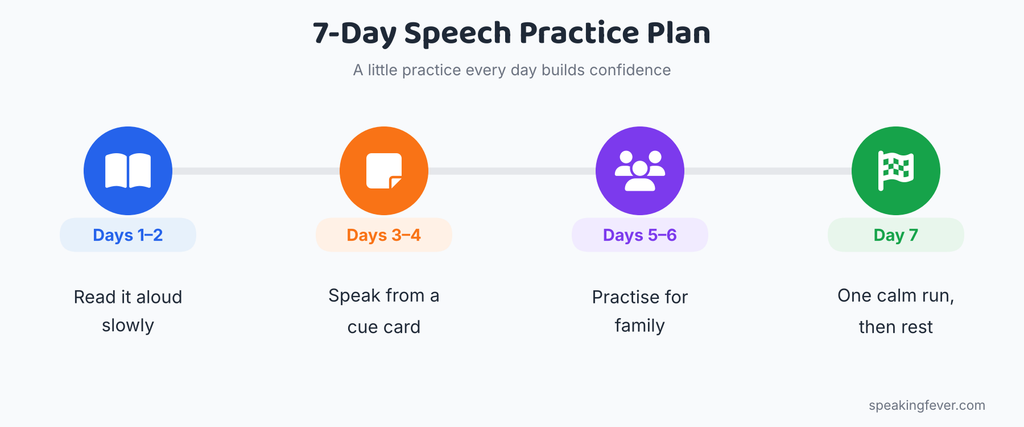
- Days 1–2: read the speech aloud slowly, twice a day.
- Days 3–4: speak from a small cue card with 4–5 keywords, not the full text.
- Days 5–6: practise in front of family, standing up, as if on stage.
- Record one practice: on Day 5 or 6, record the speech on a phone and watch it together. Look at speed and eye contact, not small mistakes.
- Day 7: one calm full practice, then rest. Avoid practising too much on the last night.
Step 5: Work on delivery
- Speak slowly: nervous children often rush. A short pause after each sentence helps.
- Speak loudly enough: imagine talking to a friend in the last row.
- Look up: look at two or three friendly faces instead of the floor.
- Stand still: feet slightly apart, hands relaxed or holding the cue card.
- Smile: at the start and the end. It relaxes both your child and the audience.
If your child also takes part in debates or elocution, a public speaking course for kids can build these skills further.
How to Overcome Stage Fear for Kids?
Stage fear is normal. Even adults feel a fast heartbeat, shaky hands or a dry mouth before speaking in public. In a 2017 study of 1,135 university students in Brazil, 63.9% said they were afraid of public speaking. The goal is not to remove the nerves completely, but to help your child speak well even when they feel them.
Tips for children
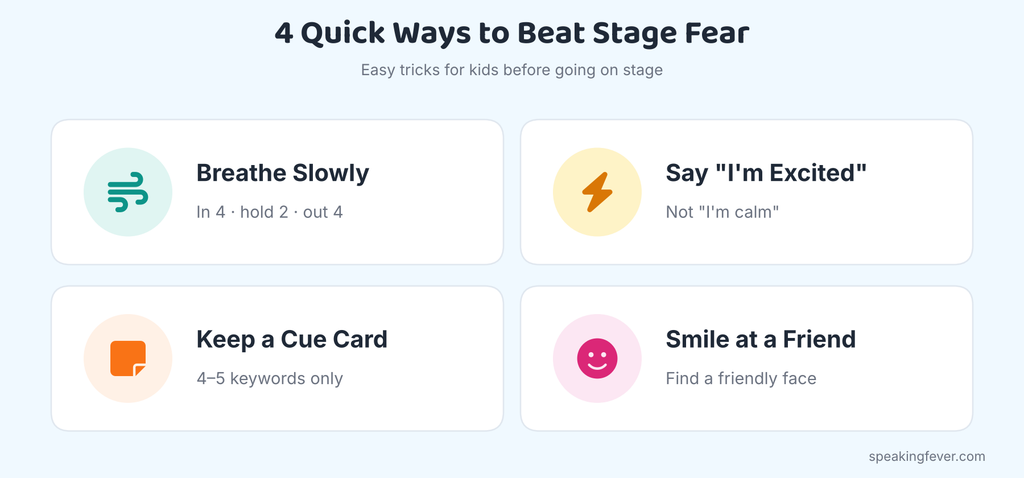
- Breathe slowly: breathe in for 4 counts, hold for 2, and breathe out for 4. Repeat three times before going on stage.
- Say “I’m excited”: in a study of adults published by the American Psychological Association, people who said “I am excited” before giving a speech came across as more persuasive, competent and relaxed than those who said “I am calm”. Nerves and excitement feel similar, so calling them excitement helps.
- Picture it going well: before sleeping, imagine walking on stage, smiling and finishing with the audience clapping.
- See the stage early: if possible, stand on the stage or in the assembly area before the event, so it feels familiar.
- Keep a cue card: a small card with 4–5 keywords is a safety net, so your child doesn’t fear going blank.
- Focus on the message: remind your child that the audience wants to hear what they have to say, not to judge them.
Tips for parents
- Make practice fun: let your child practise for toys, grandparents or a video call with relatives. The same daily habits that help you teach your child to speak English at home make speech practice easier too.
- Praise effort: say “You spoke so clearly” rather than pointing out every small mistake.
- Share your own story: tell your child about a time you felt nervous and still did well.
- Don’t say “Don’t be nervous”: it can make children feel their nerves are wrong. Say “It’s okay to feel nervous. You’ve practised, and you’re ready.”
- Never force it: if your child is very upset, start with a smaller audience and build up slowly.
Regular speaking practice is the long-term cure for stage fear. Children who speak with a trainer every week often feel more relaxed on stage, which is why 1-to-1 spoken English classes help raise confidence.
If your child’s fear is very strong or stops them from going to school or joining activities, talk to their class teacher or school counsellor.
Short Children’s Day Speech for Kids: 4 Samples
Use these samples as a starting point. Change a line or two so the speech sounds like your child, and add their name and class.
1. Very short speech for little kids (Nursery to Class 2, about 30 seconds)
About 45 words
Good morning, everyone. My name is ___. Today is Children’s Day. We celebrate it on the birthday of Chacha Nehru. He loved children very much. Children are like flowers in a garden. Let us smile, play and learn every day. Happy Children’s Day! Thank you.
2. 1 minute Children’s Day speech (Classes 3 to 5)
About 105 words
Good morning, respected Principal, teachers and my dear friends. Today I am going to speak about Children’s Day. Every year, India celebrates Children’s Day on 14 November, the birthday of Pandit Jawaharlal Nehru, our first Prime Minister. He loved children so much that they called him Chacha Nehru. He believed that children are the future of our country. For me, Children’s Day is a reminder that every child deserves to learn, play and be happy. So today, let us be kind to each other, share with our friends and thank our teachers for helping us grow. Happy Children’s Day to all of you. Thank you.
3. 2 minute speech (Classes 6 to 8)
About 200 words
Good morning, respected Principal, teachers and my dear friends. I am ___ from Class ___, and today I am happy to speak about Children’s Day.
Every year on 14 November, India celebrates Children’s Day. It is the birthday of Pandit Jawaharlal Nehru, India’s first Prime Minister, who was born in 1889. Nehru loved spending time with children, and they fondly called him Chacha Nehru. He believed that how we care for children today shapes the country of tomorrow.
Children’s Day is not just about games and sweets, although we all enjoy those! It reminds us that every child has the right to go to school, to play safely and to dream big. It also reminds us to be kind to children who are not as lucky as we are.
My message today is simple: let us never stop asking questions and learning new things, because curious children grow into confident adults. If I could ask for one thing this Children’s Day, it would be more time to read stories and play outside with friends.
I also want to thank our teachers, who work hard every day to help us grow. Happy Children’s Day to all of you. Thank you.
4. 10 lines on Children’s Day (Classes 1 to 5)
10 short lines, about 30–45 seconds when spoken slowly
- Children’s Day is celebrated in India every year on 14 November.
- It is the birthday of Pandit Jawaharlal Nehru.
- He was born on 14 November 1889 in Allahabad.
- He was the first Prime Minister of India.
- He loved children very much.
- Children lovingly called him Chacha Nehru.
- He believed that children are the future of our country.
- On this day, schools hold special assemblies, games and fun activities.
- Children’s Day reminds us that every child should learn, play and be happy.
- Happy Children’s Day to all my friends!
Tip: after your child practises, time the speech. If it runs over, cut a sentence instead of speaking faster.
Common Mistakes to Avoid
- Choosing a speech that is too long: long speeches are harder to remember and more likely to cause panic.
- Memorising word for word without understanding: if your child forgets one word, the whole speech can fall apart. Understanding the ideas helps them recover.
- Speaking too fast: this is the most common sign of nerves. Practise with pauses.
- Reading from paper without looking up: a cue card with keywords is better than a full page.
- Practising only the night before: short daily practice over a week builds far more confidence.
- Too many facts: one or two facts about Nehru are enough. Your child’s own message matters more.
Help Your Child Speak Confidently All Year?
Disclosure: Speaking Fever is our own platform.
One good Children’s Day speech is a great start, but confidence grows with regular practice. Speaking Fever runs live 1-to-1 online spoken English and public speaking classes for children aged 5–15, with storytelling, everyday conversations and public speaking built into the course.
- 1-to-1 attention: your child gets the trainer’s full attention in every 35-minute class.
- Safe space to make mistakes: gentle correction helps shy children open up.
- Plans from ₹3,999 per month, with weekly updates for parents.
Want your child to feel ready for the stage? Book a ₹11 demo class and let them practise their Children’s Day speech with a trainer.
Conclusion
A Children’s Day speech doesn’t need to be long or perfect to be special. Keep it short, use the simple 4-part structure, practise a little every day for a week, and help your child see their nerves as excitement. Most of all, praise the effort. A child who feels proud after their first speech is far more likely to volunteer for the next one. Every speech also builds the confidence that shows why English speaking is important in school life.
Reach us via
Book Your Slot with Our Trainer:
FAQs
When is Children’s Day in 2026?
Children’s Day in India is on Saturday, 14 November 2026. It marks the 137th birth anniversary of Pandit Jawaharlal Nehru.
Why is Children’s Day celebrated on 14 November?
It is Jawaharlal Nehru’s birthday. He was born on 14 November 1889 and loved children, who called him Chacha Nehru. India celebrated Children’s Day on 20 November until his death in 1964, after which it moved to his birthday.
How many words should a 1 minute Children’s Day speech have?
About 100–120 words. Young children speaking on stage should talk slowly, so a shorter speech is better than rushing a long one.
How do I start a Children’s Day speech?
Start with a polite greeting, such as “Good morning, respected Principal, teachers and my dear friends”, then say your name and what you will speak about.
How can I help my child overcome stage fear?
Practise a little every day, let your child perform for family first, teach slow breathing, and praise effort instead of perfection. Telling them it’s okay to feel nervous also helps.
Should my child memorise the speech word for word?
It’s better to understand it than to memorise every word. Practising from a cue card with keywords helps your child recover easily if they forget a line.
What should my child do if they forget a line on stage?
Pause, take a breath and look at the cue card, then carry on. The audience usually doesn’t notice a short pause.