IELTS Speaking Part 1 Topics 2026: 15 Must-Know Questions With Expert Answers

Key Takeaways:
IELTS Speaking Part 1 is a 4–5 minute interview in which the examiner asks about 12 short questions on familiar topics such as your home, work, studies and interests. Here is what you need to know for 2026:
- What to expect: the examiner usually starts with your hometown, home, or work or studies, then moves to two other everyday topics.
- How to answer: give 2–4 sentences for each question: a direct answer, a reason, and a short example or detail.
- What examiners mark: fluency and coherence, vocabulary, grammar and pronunciation, each worth an equal share of your Speaking score.
- Common topics: work or study, hometown, home, daily routine, hobbies, reading, music, food, weather, friends, technology, shopping, weekends and transport.
- What to avoid: one-word answers, long speeches and memorised answers, which examiners can usually spot.
Best way to prepare: practise answering new questions out loud every day, record yourself, and get feedback from a trainer on what is holding your band back.
Introduction
IELTS Speaking Part 1 is a 4–5 minute interview about your daily life, and it is the examiner’s first impression of you. This guide gives you 15 common topics with sample answers, a simple 3-step answer method and the mistakes to avoid, so you can start strong and move on confidently to the IELTS Speaking Part 2 cue cards.
Need full test prep? Our online IELTS preparation course gives you 20 live 1-to-1 sessions of 1 hour in 4 weeks for ₹10,000. With the exam itself costing ₹19,000 in India, our IELTS coaching fees in India guide helps you plan your total budget.
Table of Content
IELTS Speaking Part 1 Format: What Happens in the Test
The IELTS Speaking test is a face-to-face conversation with a certified examiner. It lasts 11–14 minutes in total and is the same for IELTS Academic and General Training. Part 1 is the opening section.
| Part 1 detail | What to expect |
|---|---|
| Length | 4–5 minutes |
| What happens | The examiner introduces themselves, checks your identity and asks general questions |
| Number of questions | About 12 short questions |
| Topics | Familiar subjects such as home, family, work, studies and interests |
| What is tested | Your ability to give information and opinions on everyday topics |
After Part 1 comes Part 2, where you speak for up to 2 minutes on a cue card, and Part 3, a deeper discussion. You can practise Part 2 with our IELTS cue cards PDF with Band 8 answers.
How Part 1 is scored?
The examiner marks your whole Speaking test on four criteria:
- Fluency and coherence: speaking at a normal pace without long pauses, and linking ideas clearly.
- Lexical resource: using a good range of vocabulary accurately, and finding other words when you don’t know one.
- Grammatical range and accuracy: using a mix of sentence structures with few mistakes.
- Pronunciation: speaking so the examiner can understand you without effort.
Part 1 questions are simple, but they give the examiner an early picture of all four criteria. You can see what each band means in the official IELTS Speaking band descriptors.
How to Answer IELTS Speaking Part 1 Questions?
The best Part 1 answers are short, direct and natural. Use this 3-step method for almost any question:
- Answer: reply to the question directly in one sentence.
- Reason: say why.
- Example or detail: add one real example, a time, a place or a comparison.
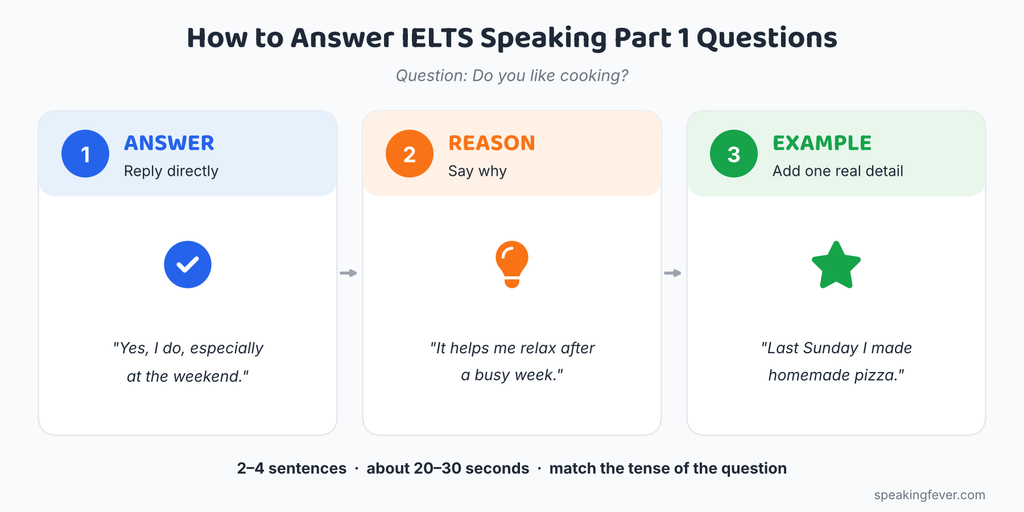
This gives you 2–4 sentences, which is usually enough. The examiner will move on when they have heard enough.
Example question: Do you like cooking?
- Weak answer: “Yes, I like cooking.”
- Better answer: “Yes, I do, especially at the weekend. Cooking helps me relax after a busy week, and I like trying new recipes. Last Sunday, for example, I made homemade pizza for the first time, and it turned out better than I expected.”
The better answer answers directly, gives a reason, adds a real example and uses a mix of present and past tenses.
Tips that help your band score
- Use your own words: don’t repeat the question word for word. For “Do you enjoy reading?” you can start with “Yes, I’m quite a keen reader.”
- Change tenses naturally: many questions invite the past (“Did you… as a child?”) or the future (“Would you like to…?”). Answer in the same tense.
- Be honest: you don’t need an impressive answer. Simple, true answers sound more natural and are easier to extend.
- Use natural phrases to think: “That’s an interesting question” or “Let me think…” sounds better than a long silence.
- Ask for a repeat if needed: if you didn’t hear a question, you can politely ask the examiner to repeat it. According to IDP, this doesn’t cost you marks, but in Part 1 the examiner will only repeat the same question, not explain it.
- If you work and study: IDP advises choosing one and answering about that, instead of telling the examiner you do both.
Band 6 vs Band 7: Same Question, Different Answers
The difference between a Band 6 and a Band 7 answer is often small: fewer errors, more precise words and one real detail. These examples show the kind of change that helps. Only an examiner can give an official band.
Question: Do you like your hometown?
- Band 6-style answer: “Yes, I like my hometown very much. It is very good place and people are very friendly. I like it.”
- Band 7-style answer: “Yes, I’m very fond of it. It’s not a big city, but it has a relaxed pace of life, and the people are genuinely friendly. Whenever I visit, I feel like I can finally slow down.”
- What changed: no repetition, more precise vocabulary (“relaxed pace of life”, “genuinely”), no grammar errors and a personal detail.
Question: Do you prefer reading books or watching films?
- Band 6-style answer: “I prefer watching films because it is easy and I don’t have time for read books.”
- Band 7-style answer: “Films, if I’m honest. After a long day, it’s easier to relax in front of a screen than to concentrate on a book. That said, on holidays I do enjoy getting lost in a good novel.”
- What changed: the grammar error (“time for read”) is gone, and the answer adds a contrast with “That said”.
Question: Did you enjoy school as a child?
- Band 6-style answer: “Yes, I enjoy my school. I have many friends and teachers are good.”
- Band 7-style answer: “Yes, I really enjoyed it, especially primary school. I had a great group of friends, and one of my teachers made science so much fun that it became my favourite subject.”
- What changed: the past tense is correct, the answer gives a real example, and it uses a longer, linked sentence.
IELTS Speaking Part 1 Topics 2026 With Questions and Sample Answers
IELTS does not publish its Speaking questions, and the exact questions change over time, so no list can tell you what you will be asked. The topics below are the familiar, everyday subjects that Part 1 is built around. Use them to practise answering new questions, not to memorise answers.
Each topic has a sample answer written at a natural, high-band level, with a short note on why it works. Change the details so they are true for you.
Download the PDF & get all 15 topics, 60 questions and sample answers in one printable PDF.
Core topics: the examiner usually starts here
1. Work
- What do you do?
- Why did you choose this job?
- What do you like most about your work?
- Would you like to change your job in the future?
Sample answer (What do you like most about your work?): “I work as a software tester, and what I enjoy most is the problem-solving. Every day there’s a new bug to track down, so it never feels repetitive. I also like my team. We’re quite close, and we often grab lunch together after a long testing cycle.”
Why it works: it answers directly, gives two reasons (the problem-solving and the team) and adds a real detail about lunch with colleagues.
2. Studies
- What are you studying?
- Why did you choose this subject?
- What is the most difficult part of your course?
- What do you plan to do after you finish?
Sample answer (Why did you choose this subject?): “I’m studying commerce, mainly because I’ve always been good with numbers. My father runs a small business, so I grew up watching him manage accounts, and that made me curious about how companies work. In the future, I’d like to do an MBA abroad.”
Why it works: it links the choice to a personal story and ends with a future plan, so it mixes present, past and future tenses.
3. Hometown
- Where is your hometown?
- What is it known for?
- Has your hometown changed much in recent years?
- Would you like to live there in the future?
Sample answer (Has your hometown changed much in recent years?): “Yes, quite a lot. I grew up in a mid-sized city, and when I was a child it felt like a quiet town. Now there are new roads, shopping malls and IT offices on the outskirts. It’s more convenient, but I do miss how peaceful it used to be.”
Why it works: it compares the past and the present clearly (“when I was a child… Now…”) and gives a balanced view with “but”.
4. Home and accommodation
- Do you live in a house or a flat?
- Which room do you like most, and why?
- Who do you live with?
- Would you like to move to a different home in the future?
Sample answer (Which room do you like most?): “Probably the balcony, if that counts as a room. It’s small, but it gets the morning sun, and I’ve filled it with plants. I usually drink my tea there before work, so it’s the calmest part of my day.”
Why it works: it starts naturally (“Probably…, if that counts as a room”) and uses precise details: the morning sun, the plants and tea before work.
Common everyday topics
5. Daily routine
- What do you usually do in the morning?
- Is your routine different at the weekend?
- Have you changed your routine recently?
- Do you prefer mornings or evenings?
Sample answer (Do you prefer mornings or evenings?): “I’m definitely a morning person. I feel fresh and focused, so I try to do my most important work before lunch. By the evening I’m usually tired, so I keep it light and just watch something or call my family.”
Why it works: it gives a clear preference, explains it, and contrasts mornings with evenings.
6. Hobbies and free time
- What do you do in your free time?
- Did you have the same hobbies as a child?
- Is there a new hobby you would like to try?
- Do you prefer spending free time alone or with others?
Sample answer (Is there a new hobby you would like to try?): “I’d really like to learn photography. My cousin takes amazing pictures on his trips, and it made me realise how much a good photo can capture. I’ve already started watching a few tutorials, so I might buy a basic camera next year.”
Why it works: it explains where the interest came from, uses a natural phrase (“made me realise”) and shows a future plan with “might”.
7. Reading
- Do you like reading?
- What kind of books do you enjoy?
- Do you prefer printed books or e-books?
- Did you read a lot as a child?
Sample answer (Do you prefer printed books or e-books?): “I prefer printed books. I spend most of the day looking at screens, so holding a real book feels more relaxing. That said, I do read on my phone when I’m travelling, because it’s much easier than carrying a heavy novel.”
Why it works: it gives a reason linked to daily life and adds a contrast with “That said”, which shows range.
8. Music
- What kind of music do you like?
- When do you usually listen to music?
- Have your music tastes changed over the years?
- Can you play a musical instrument?
Sample answer (When do you usually listen to music?): “Mostly on my commute. The traffic can be stressful, so I put on my favourite old songs and it makes the journey much more pleasant. I also play soft instrumental music when I’m studying, because songs with lyrics distract me.”
Why it works: it describes two situations, each with a reason, and uses topic words like “commute”, “instrumental” and “lyrics”.
9. Food and cooking
- What is your favourite food?
- Do you prefer eating at home or eating out?
- Can you cook?
- Is there any food you didn’t like as a child but enjoy now?
Sample answer (Do you prefer eating at home or eating out?): “Usually at home. Home food is healthier, and nothing really beats my mother’s cooking. But I do enjoy eating out once in a while, maybe on a birthday or when friends visit, because it’s a nice way to try something different.”
Why it works: it answers with “usually”, gives reasons, then adds exceptions with examples (birthdays and friends visiting).
10. Weather
- What is the weather like where you live?
- What is your favourite season?
- Does the weather affect your mood?
- Do you check the weather forecast?
Sample answer (What is your favourite season?): “I love the rainy season. After months of heat, the first rain feels amazing, and everything turns green. The only downside is the traffic and waterlogged roads, but a hot drink and a good book on a rainy evening make up for it.”
Why it works: it uses descriptive language (“everything turns green”) and mentions a downside, so the answer sounds balanced and real.
11. Friends
- Do you have many friends?
- How often do you meet your friends?
- What do you usually do together?
- Is it easy to make new friends as an adult?
Sample answer (Is it easy to make new friends as an adult?): “Honestly, I find it harder than when I was in school. Back then, you saw the same people every day. Now everyone is busy with work and family, so friendships take more effort. Most of my new friends are actually colleagues.”
Why it works: it starts honestly, compares school with adult life and ends with a personal detail.
12. Mobile phones and apps
- How often do you use your phone?
- Which app do you use the most?
- Do you think people spend too much time on their phones?
- What did you use your first phone for?
Sample answer (Which app do you use the most?): “Probably WhatsApp. I use it for almost everything: chatting with family, office groups, even sharing documents. I’d like to cut down on social media, though, because I sometimes lose an hour just scrolling without noticing.”
Why it works: it names the app, gives examples of how it is used, and adds a personal goal with “I’d like to…, though”.
13. Shopping and clothes
- Do you enjoy shopping?
- Do you prefer shopping online or in stores?
- What kind of clothes do you usually wear?
- Do you wear traditional clothes on special occasions?
Sample answer (Do you prefer shopping online or in stores?): “It depends on what I’m buying. For electronics and books, I shop online because the prices are better and it saves time. But for clothes I prefer going to a store, because I like to try things on and check the fabric first.”
Why it works: “It depends” is a natural start, and the answer gives two clear cases, each with a reason.
14. Weekends
- What do you usually do at the weekend?
- Did you do anything special last weekend?
- Do you prefer busy or relaxing weekends?
- How were your weekends different when you were a child?
Sample answer (Did you do anything special last weekend?): “Yes, I went on a short hike to a hill near my city with a few friends. We started early to avoid the heat, and the view from the top was beautiful. I came back exhausted but in a really good mood.”
Why it works: it uses past tenses correctly and tells a short story with a start, a detail and a feeling.
15. Transport
- How do you usually travel to work or college?
- What is public transport like in your city?
- Do you prefer travelling by bus or by train?
- Would you like to learn to drive?
Sample answer (What is public transport like in your city?): “It’s improving. A few years ago we only had crowded buses, but now there’s a metro line, which is clean and much faster. It doesn’t cover every area yet, so many people still depend on taxis or their own cars.”
Why it works: it compares “a few years ago” with “now” and gives a balanced view of what still needs to improve.
Common Mistakes That Lower Your Part 1 Score
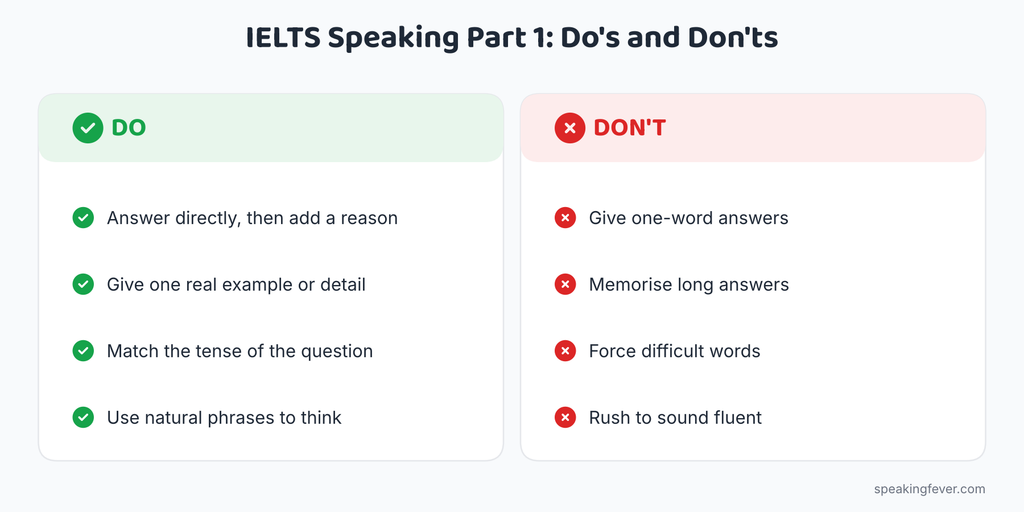
- One-word answers: “Yes” or “No” gives the examiner nothing to assess. Always add a reason or an example.
- Memorised answers: IDP warns that memorised responses stand out to examiners and can affect your score. They also often don’t fit the exact question.
- Very long answers: Part 1 is a quick interview. Talking for a full minute on every question can make you lose focus and leaves less time for other questions.
- Forcing difficult words: using rare words wrongly hurts your lexical resource score. Accurate, natural vocabulary is better than impressive but wrong vocabulary.
- Speaking too fast: rushing to sound fluent usually makes pronunciation unclear and adds grammar mistakes.
- Using only the present tense: many questions ask about your past or future. Mixing tenses correctly shows grammatical range.
If you often struggle to find the right words, building your everyday vocabulary first helps a lot. An advanced English speaking course can make your answers sound more natural before test day.
How to Practise IELTS Speaking Part 1
Part 1 improves fastest with short, regular practice. Try this simple routine:
- Pick 3 topics a day from the list above and answer each question out loud.
- Use a timer: aim for about 20–30 seconds per answer, using the Answer, Reason, Example method.
- Record yourself and listen for long pauses, repeated words and grammar mistakes.
- Make a mistake list and work on one problem each week, such as past tenses or filler words.
- Take a full mock test with Parts 1, 2 and 3 every week or two, so you get used to the real timing.
AI apps and recordings are useful for daily repetition, but they cannot always tell you which criterion is holding your band back. Our guide to IELTS speaking practice online with a real trainer explains how to combine both.
Practise Part 1 with a Speaking Fever IELTS trainer
Disclosure: Speaking Fever is our own platform.
Speaking Fever’s IELTS preparation course gives you live 1-to-1 online classes with an IELTS trainer, mock speaking interviews based on the real test format, and feedback after every session. The 4-week course costs ₹10,000 for 20 live 1-hour sessions and covers all four modules: Speaking, Reading, Writing and Listening.
Conclusion
IELTS Speaking Part 1 rewards natural, confident answers, not perfect ones. You will not know the exact questions in advance, but you can be ready for any of them by practising the common topics, using the Answer, Reason, Example method, and keeping each answer to a few clear sentences.
Start with the 15 topics in this guide, change the sample answers so they are true for you, and practise out loud every day. A few weeks of regular speaking practice, with honest feedback on your mistakes, will make Part 1 feel like a relaxed conversation on test day.
Want to know your Speaking band before test day? Book a ₹11 demo class and answer real Part 1 questions with a trainer.
Reach us via
Book Your Slot with Our Trainer:
FAQs
1. How many questions are asked in IELTS Speaking Part 1?
Usually about 12 short questions across a few topics. Part 1 lasts 4–5 minutes, so the number can vary slightly depending on the length of your answers.
2. What are the most common IELTS Speaking Part 1 topics?
The examiner usually starts with your work or studies, your hometown or your home. After that, common topics include daily routine, hobbies, reading, music, food, weather, friends, phones, shopping, weekends and transport.
3. How long should my Part 1 answers be?
Aim for 2–4 sentences, about 20–30 seconds. Answer the question directly, give a reason, and add one example or detail.
4. Are the IELTS Speaking Part 1 questions for 2026 published?
No. IELTS does not publish its Speaking questions. Lists online, including this one, are based on the familiar topics that Part 1 uses, so practise answering new questions rather than memorising answers.
5. Can I memorise answers for IELTS Speaking Part 1?
It is not a good idea. Memorised answers often sound unnatural and may not fit the exact question. Learn useful vocabulary and the answer method instead, and practise using them in fresh answers.
6. Is IELTS Speaking Part 1 the same for Academic and General Training?
Yes. Both versions use the same Speaking test, with the same three parts and the same four marking criteria. The Speaking test is also a live conversation with an examiner whichever format you choose for the other sections.
7. What if I don’t understand a Part 1 question?
You can politely ask the examiner to repeat the question, for example: “Sorry, could you repeat the question, please?” It is better than guessing and giving an answer that doesn’t fit.
8. Does Part 1 affect my overall Speaking band?
Yes. The examiner gives one Speaking band for the whole test, based on all three parts. A confident Part 1 also helps you relax for Parts 2 and 3.