12 IELTS Speaking Mistakes Indian Students Make (+ Fixes)

Key Takeaways
Most Indian students lose IELTS Speaking marks because of a few fixable habits, not weak English. Fix these first:
- Don’t memorise answers. Examiners are trained to spot them. Prepare ideas, not scripts.
- Extend every answer. In Part 1, give an answer, a reason and a short example. In Part 2, keep talking for the full 2 minutes.
- Swap Indian English phrases like “I am having a doubt” or “I passed out in 2023” for standard English.
- Slow down and stress key words. Fast, flat speech hurts your pronunciation score more than your accent does.
- Mix simple and complex sentences. A Band 7 needs frequent error-free sentences, not only short ones.
- Practise out loud and record yourself. Reading tips is not the same as speaking.
Introduction
The IELTS Speaking test lasts only 11–14 minutes, but for many Indian students it decides whether they reach their target score. For Canada’s Federal Skilled Worker Program, you need at least 6.0 in IELTS General Training Speaking (CLB 7), and a 7.0 counts as CLB 9. Australia’s “Proficient English” level asks for at least 7 in each of the four test components, including Speaking.
Yet many students who read and write English well get stuck at Band 6 in Speaking. The cause is rarely a lack of knowledge. It is a small set of habits, such as memorised answers, fast and flat speech, and Indian English phrases, that the examiner notices within the first few minutes of a recorded interview. Speaking Fever’s IELTS preparation course is built to fix exactly these habits through live 1-to-1 speaking practice with a trainer.
This guide covers the 12 most common mistakes, the criterion each one affects, and how to fix it.
IELTS speaking mistakes at a glance
| Mistake | Quick fix | Criterion affected |
|---|---|---|
| One-line answers in Part 1 | Answer + reason + example | Fluency and coherence |
| Memorised answers | Prepare ideas, not scripts | Fluency and coherence |
| Long pauses and fillers | Use natural linking phrases | Fluency and coherence |
| Stopping early in Part 2 | Use the 1-minute notes; talk for 2 minutes | Fluency and coherence |
| Repeating basic words | Learn topic words and collocations | Lexical resource |
| Forcing big words and idioms | Use words you know well | Lexical resource |
| Indian English expressions | Swap for standard English | Lexical resource |
| “I am having” type errors | Simple tense for states | Grammar |
| Missing articles, mixed tenses | Check a, an, the and past tense | Grammar |
| Only short, simple sentences | Add because, which, if, although | Grammar |
| Speaking too fast and flat | Slow down; stress key words | Pronunciation |
| Faking a foreign accent | Aim to be clear, not British | Pronunciation |
How IELTS Speaking Is Marked?
The test is an 11–14 minute recorded interview in three parts:
- Part 1 (4–5 minutes): questions on familiar topics.
- Part 2 (3–4 minutes): a cue card, with 1 minute to prepare and about 2 minutes to speak.
- Part 3 (4–5 minutes): a deeper discussion linked to Part 2.
You are marked on four criteria: fluency and coherence, lexical resource (vocabulary), grammatical range and accuracy, and pronunciation, based on your average performance across all three parts.
12 Common Mistakes in IELTS Speaking Indian Students Make (and How to Fix Them)
The mistakes are grouped by the criterion they affect, so you can see where your marks are going.
Fluency and coherence mistakes
1. Giving one-line answers in Part 1
- Examiner: Do you like cooking?
- Weak: “Yes, I like cooking.”
- Better: “Yes, I do, especially on weekends. It helps me relax after a busy week, and recently I’ve started trying simple pasta recipes.”
Fix: use answer + reason + example, about 2–3 sentences. Practise with these IELTS Speaking Part 1 topics.
2. Memorising answers
According to the British Council, memorised answers are very obvious and examiners are trained to spot them. They also rarely fit the exact question.
Fix: prepare ideas and vocabulary for common topics, not full scripts, and practise new questions in your own words.
3. Long pauses and filler words
Repeating “basically”, “actually”, “like” or “umm” makes you sound unsure. The official Band 6 description says coherence “may be lost at times as a result of hesitation, repetition and/or self-correction”.
Fix: use natural thinking phrases like “Let me think” or “Well, it depends”. Record a 1-minute answer and count your fillers.
4. Wasting the Part 2 minute and stopping early
Fix: write 4–5 keywords, one for each point on the card, and add one personal story. If you finish early, add how you felt or what you learned. Time yourself with these IELTS cue cards.
Vocabulary mistakes
5. Repeating basic words
Using “good”, “nice”, “very” and “big” again and again limits your lexical resource score.
Fix: learn natural word pairs (collocations) such as “heavy traffic” and “a tight budget”, and paraphrase the examiner’s question instead of repeating it.
6. Forcing big words and idioms
Rare words and idioms used in the wrong place sound unnatural. Band 7 asks only for “some ability to use less common and idiomatic items”.
Fix: use a word only if you know its meaning and how to say it. “I’m not a big fan of…” works better than a rare dictionary word. For more simple, practical advice, read our IELTS speaking tips for beginners.
7. Using Indian English expressions
Phrases like “I am having a doubt” or “I passed out from college in 2023” are common in India but are not standard English. See the full list of swaps in the next section.
Grammar mistakes
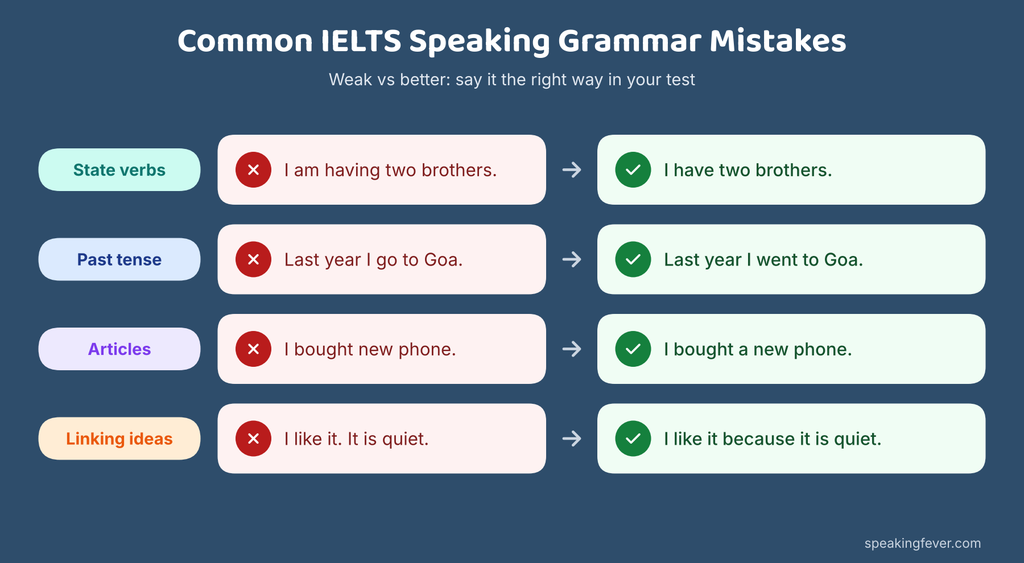
8. Using “-ing” with state verbs
- Weak: “I am having two brothers.” / “I am knowing the answer.”
- Better: “I have two brothers.” / “I know the answer.”
Fix: use the simple tense with state verbs such as have (for possession), know, like and want. “I’m having dinner” is fine, because it is an action.
9. Missing articles and mixing tenses
- Weak: “Last year I go to Goa and buy new phone.”
- Better: “Last year I went to Goa and bought a new phone.”
Fix: practise telling short stories about the past, and check “a”, “an” and “the” in your recordings. Brush up on these essential grammar rules.
10. Using only short, simple sentences
Simple sentences feel safe, but Band 7 needs “a range of structures” used flexibly.
Fix: link ideas with because, which, although, if and used to. For example: “I used to live in a small town, which is why I still prefer quiet places.”
Pronunciation mistakes
11. Speaking too fast with a flat rhythm
Research on educated Indian English (Fuchs, 2016) finds it has a more syllable-timed rhythm than British English, which is stress-timed. Many students also speak faster when nervous. The official Band 6 description notes that “rhythm may be affected by a lack of stress-timing and/or a rapid speech rate”.
Fix: slow down, pause between ideas, and stress the key word in each phrase, for example PHO-to-graph but pho-TO-gra-phy.
12. Trying to fake a British or American accent
IDP, which co-owns IELTS, says your accent is not part of the evaluation criteria and does not affect your score. What counts is how easily you are understood. A forced accent often makes speech less clear.
Fix: keep your own accent and work on clear sounds (such as v and w, or th) and word stress.
Pronunciation habits from Indian languages to check
- v and w sounding the same: “wery well” instead of “very well”.
- z said as j: “jero” instead of “zero”.
- An extra vowel before s-words: “ischool” or “istation” instead of “school” and “station”.
- th said as t or d: “tink” instead of “think”.
Test-day tip: if you don’t hear a question, say “Sorry, could you repeat the question?” It is allowed. In Part 3 the examiner can also explain the question.
Not sure which of these mistakes you make? Book a ₹11 demo class and let a trainer check your speaking.
Before and after: one Part 3 answer, fixed
Question: Why do many young people prefer shopping online?
Before: “Basically, young people are liking online shopping because it is very good and very easy. Actually they are having less time. So they are preferring online. It is very convenient only.”
What goes wrong: fillers, “-ing” with state verbs, repeated basic words, an Indian English “only”, and no example.
After: “I think the main reason is convenience. Most young people have busy schedules, so they’d rather order something in two minutes than spend an hour in traffic. Online stores also make it easy to compare prices, which matters when you’re on a tight budget. That said, it isn’t always better, because you can’t check the quality before you buy.”
What improved: an opinion with a reason and example, linked sentences, natural collocations, and no fillers.
Indian English Phrases to Avoid in IELTS Speaking
These phrases are perfectly normal in India, but an IELTS examiner may count them as errors or unusual word choices. Swap them for the standard English versions.
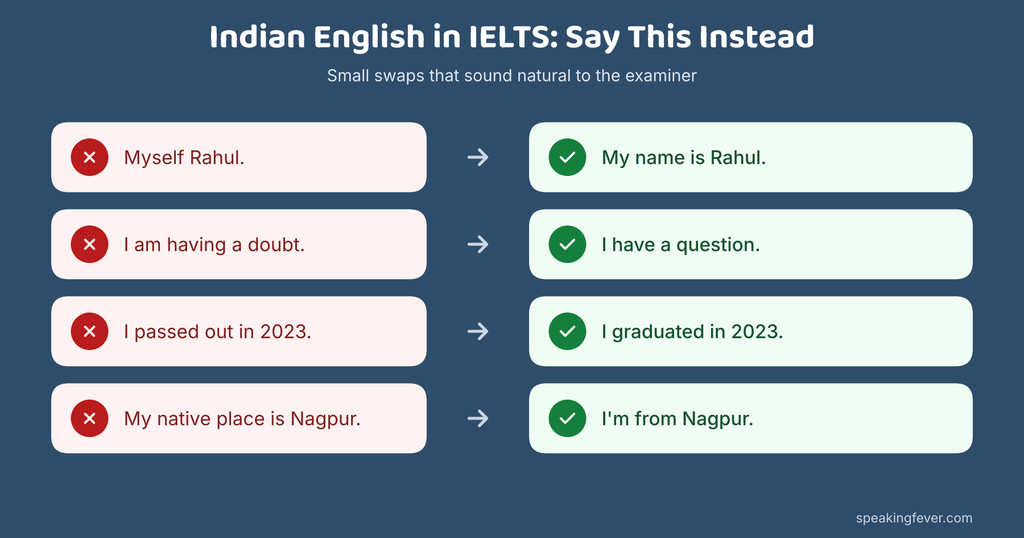
| Avoid | Say instead |
|---|---|
| Myself Rahul. | My name is Rahul. / I’m Rahul. |
| I am having a doubt. | I have a question. |
| I passed out from college in 2023. | I graduated in 2023. |
| My native place is Nagpur. | I’m from Nagpur. / My hometown is Nagpur. |
| I am staying in Pune. (meaning you live there) | I live in Pune. |
| We discussed about it. | We discussed it. |
| My cousin-brother lives in Delhi. | My cousin lives in Delhi. |
These are some of the most common mistakes Indians make while speaking English, and fixing them helps in interviews and at work too.
Get Your Speaking Mistakes Corrected by an IELTS Trainer
Disclosure: Speaking Fever is our own platform.
It is hard to spot your own mistakes. Speaking Fever’s IELTS preparation course gives you live 1-to-1 online classes with a trainer who corrects your speaking as you go.
- 1-to-1 speaking practice: 1-hour classes with evaluation and correction in every session.
- Real test practice: cue card discussions and mock speaking interviews in the official IELTS format and timing.
- 10+ mock tests with performance insights.
- Course fee: ₹10,000 for a 4-week course with 20 one-hour 1-to-1 sessions.
Conclusion
Most IELTS speaking errors Indian students make are habits, not gaps in knowledge. Stop memorising, extend your answers, use standard English phrases, and slow down so your stress is clear. Pick your top three mistakes, practise them out loud daily for four weeks, and record yourself to track progress.
Remember, the examiner is not judging your accent or whether your ideas are right. They are checking how clearly, fluently and accurately you speak. Start with the mistakes that are quickest to fix, such as one-line answers and memorised scripts. Use the Indian English table above as a checklist, practise one cue card a day with a 2-minute timer, and ask a trainer or a fluent friend to listen, because others often catch errors you miss.
Want to know your real speaking band? Book a ₹11 demo class and get your mistakes checked by a trainer.
Reach us via
Book Your Slot with Our Trainer:
FAQs
What are the most common IELTS speaking mistakes?
One-line answers, memorised answers, fillers, repeating basic words, tense and article errors, and speaking too fast. Indian students also often use Indian English phrases like “I am having a doubt”.
Does an Indian accent lower my IELTS speaking score?
No. IDP says your accent is not part of the evaluation criteria. Pronunciation is marked on how clearly you can be understood.
Can I memorise answers for IELTS speaking?
No. Examiners are trained to spot memorised answers. Prepare ideas and vocabulary for common topics instead.
How long should my IELTS speaking answers be?
In Part 1, aim for 2–3 sentences. In Part 2, speak for the full 2 minutes. In Part 3, give a longer answer with an opinion, a reason and an example.
Is it okay to disagree with the examiner?
Yes. IDP confirms you don’t need to agree with the examiner. Give your honest view with reasons.
How can I improve IELTS speaking at home?
Speak out loud every day, record your answers, and practise cue cards with a 2-minute timer.
How long does it take to fix IELTS speaking mistakes?
Habits like short answers and fillers can improve in a few weeks of daily practice. Vocabulary and grammar take longer, so start one to two months before your test.