IELTS Speaking Cue Cards PDF 2026: 100 Topics With Band 8 Answers (Free Download)

Written by: Mili Jain · Reviewed by: Aditi Pandey, IELTS Trainer at Speaking Fever, 6+ years of experience, IELTS Certified
Quick Verdict
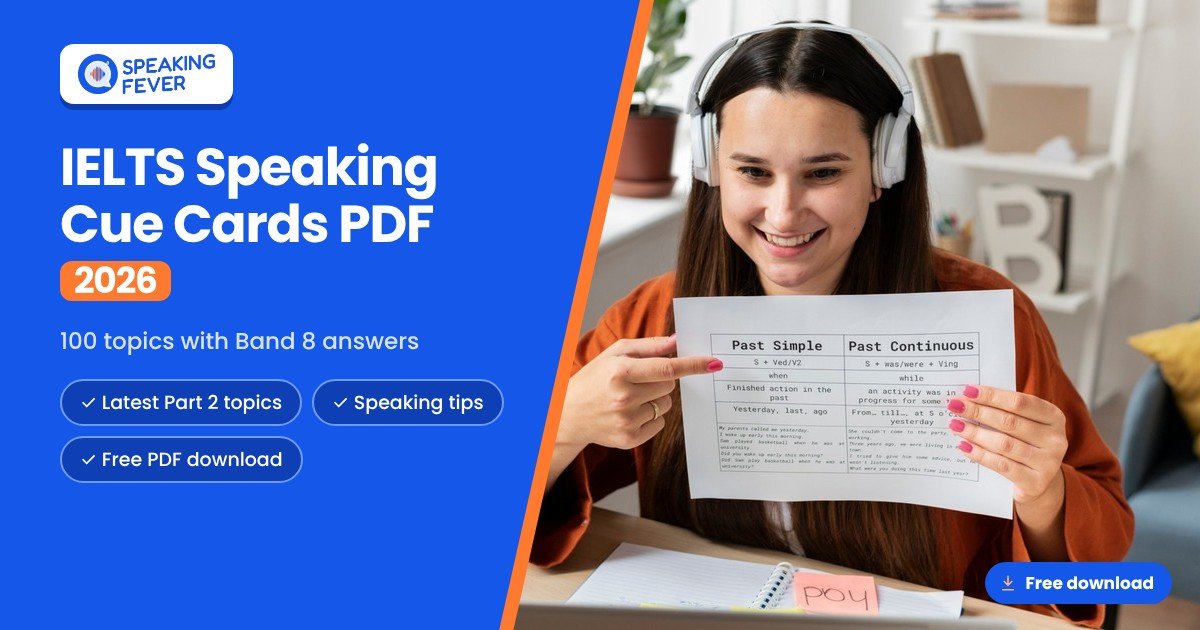
This blog gives you 100 IELTS Speaking Part 2 cue card topics for 2026 practice, grouped into 8 themes, with Band 8 model answers and a free PDF to download.
| What a cue card is: the topic you speak about in IELTS Speaking Part 2. You get 1 minute to prepare and then talk for up to 2 minutes. About “2026” cue cards: IELTS does not publish its question bank, so no list is official. These topics follow the themes that appear again and again in practice materials: people, places, objects, events, experiences, activities, media and nature. What makes a Band 8 answer: speaking fluently for the full 2 minutes, with wide and precise vocabulary, varied grammar and clear pronunciation. Best way to use the PDF: practise one cue card a day with a timer, record yourself, and compare your answer with the model, not memorise it. |
Introduction
The cue card is the part of IELTS Speaking that worries many test takers. You get a topic you have never seen, one minute to plan, and then you must speak alone for up to two minutes while the examiner listens.
The good news is that cue card topics are predictable in type, even if the exact question is not. Almost every card asks you to describe a person, a place, an object, an event, an experience, an activity, something from the media or something about nature. If you practise enough topics from each group, you will rarely face a card you cannot handle.
This guide gives you 100 practice topics, a simple structure for answering any card, Band 8 sample answers with notes, and a free IELTS cue cards 2026 PDF you can print or save on your phone.
Table of Content
What Is an IELTS Cue Card?
An IELTS cue card is the task card the examiner gives you in Speaking Part 2, also called the “long turn”. It shows one topic and three or four bullet points that suggest what to talk about. The Speaking test is the same for IELTS Academic and General Training. It is also the same whether you take the other sections on computer or on paper; see our guide to IELTS on computer vs on paper.
| Part 2 detail | What happens |
| Total time | 3–4 minutes, including preparation |
| Preparation | 1 minute, with a pencil and paper for notes |
| Speaking time | Up to 2 minutes; the examiner stops you when time is up |
| Follow-up | The examiner may ask one or two short questions on the same topic |
| What comes next | Part 3, a 4–5 minute discussion linked to your cue card topic |
Source: IELTS Speaking test format.
How to Answer an IELTS Cue Card for Band 8?
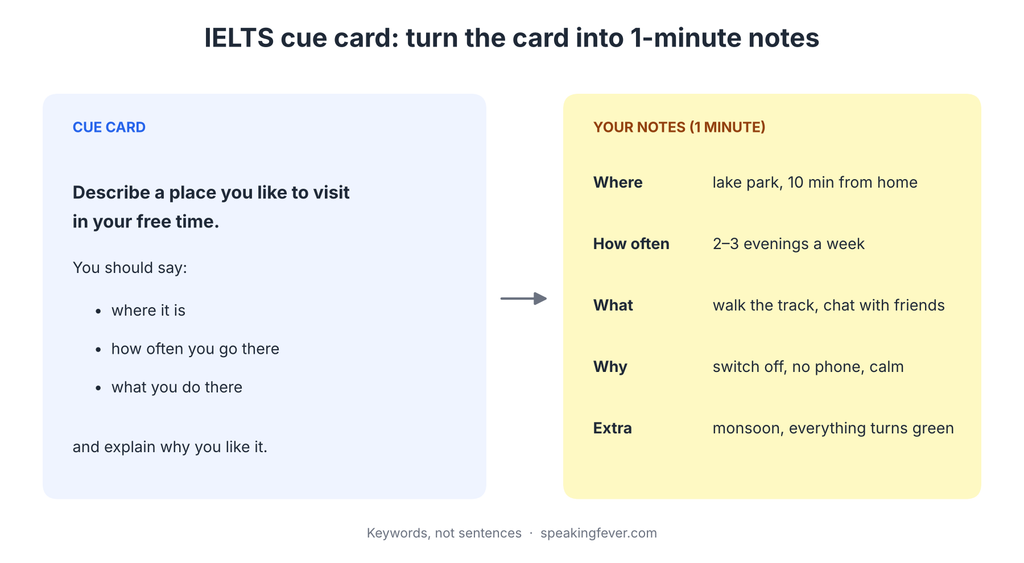
Use the 1 minute to plan, not to write sentences
Write 5–6 keywords, one line for each bullet point, plus one feeling or reason for the last line. Full sentences take too long and make you read instead of speak.
Book a trial class with an IELTS trainer today!
Follow a simple 4-step structure
- Open (10 seconds): say what you will talk about. “I’d like to talk about a book that really changed how I think about money.”
- Describe (60 seconds): cover the bullet points with details such as names, places, times and small stories.
- Explain (30 seconds): answer the last line, usually why or how you felt. This is where Band 8 vocabulary shows.
- Close (10–20 seconds): finish with a short reflection, then keep adding detail until the examiner stops you.
What Band 8 actually means?
The examiner scores Part 2 on the same four criteria as the rest of the Speaking test. Each one counts for 25% of your Speaking band. The official descriptors describe Band 8 like this:
| Criterion | Band 8 in the official descriptors | What it means for your cue card |
| Fluency and coherence | “Speaks fluently with only occasional repetition or self-correction” | Keep talking for 2 minutes with clear links between ideas |
| Lexical resource | “Uses less common and idiomatic vocabulary skilfully” | Use precise words and natural phrases, not memorised “big” words |
| Grammatical range and accuracy | “Produces a majority of error-free sentences” | Mix simple and complex sentences, with few mistakes |
| Pronunciation | “Is easy to understand throughout” | Clear stress and intonation; your accent is fine |
For more ways to practise these skills, read our guide to IELTS speaking practice online with a real trainer.
100 IELTS Cue Card Topics for 2026 Practice
These 100 topics are grouped into the 8 themes that cue cards usually cover. They are practice topics, not leaked exam questions. If you can speak for 2 minutes on most of these, you will be ready for almost any card. The free PDF shows every topic as a full cue card, with its “You should say” bullet points.
People (1–14)
- Describe a person who inspires you
- Describe a family member you are close to
- Describe a teacher who influenced you
- Describe a friend you have known for a long time
- Describe a person who helped you in a difficult time
- Describe a famous person you would like to meet
- Describe an elderly person you respect
- Describe a person who is very good at their job
- Describe a neighbour you know well
- Describe a child you know
- Describe a person who speaks a foreign language well
- Describe a creative person you admire
- Describe someone who gave you good advice
- Describe a person who enjoys cooking
Places (15–27)
- Describe a place you like to visit in your free time
- Describe a city you would like to visit
- Describe a historical place you have visited
- Describe a park or garden you enjoy
- Describe a quiet place where you like to relax
- Describe your favourite café or restaurant
- Describe a place where you study or work well
- Describe a beautiful place in your country
- Describe a place near water that you enjoyed
- Describe a crowded place you have been to
- Describe a market or shopping centre you like
- Describe a house or flat you would like to live in
- Describe a place that was different from what you expected
Objects (28–40)
- Describe a special gift you received
- Describe something you bought that made you happy
- Describe a piece of technology you use every day
- Describe a book you enjoyed reading
- Describe an old object your family has kept
- Describe a photo you like
- Describe something you lost and found again
- Describe an item of clothing you like to wear
- Describe a piece of furniture you like
- Describe a toy you liked as a child
- Describe a vehicle you would like to own
- Describe something you made by hand
- Describe a useful app on your phone
Events and Experiences (41–54)
- Describe a memorable trip you took
- Describe a celebration in your family
- Describe a festival you enjoy
- Describe a time you felt proud of yourself
- Describe a time you helped someone
- Describe a time you made a difficult decision
- Describe a time you were late for something important
- Describe a time you tried something new
- Describe a wedding you attended
- Describe a time you received good news
- Describe a mistake you made and what you learned
- Describe a time you had to wait for something
- Describe a time you changed your mind
- Describe a surprise you enjoyed
Activities and Hobbies (55–66)
- Describe a hobby you enjoy
- Describe a sport you like to play or watch
- Describe a skill you would like to learn
- Describe an outdoor activity you did recently
- Describe a game you enjoyed as a child
- Describe a dish you can cook
- Describe how you relax after a busy day
- Describe a habit you want to change
- Describe a team activity you took part in
- Describe something you do to stay healthy
- Describe a class or course you enjoyed
- Describe an activity you do with your family
Media and Technology (67–78)
- Describe a film you enjoyed watching
- Describe a TV programme you like
- Describe a song that is special to you
- Describe a website you visit often
- Describe a piece of news you heard recently
- Describe an advertisement you remember
- Describe a social media account you follow
- Describe a time technology made your life easier
- Describe a podcast or radio programme you like
- Describe a story you heard as a child
- Describe an interesting talk or lecture you attended
- Describe an article you read in a newspaper or magazine
Nature and Environment (79–88)
- Describe a natural place you have visited
- Describe an animal you like
- Describe a time you saw a beautiful sky
- Describe a kind of weather you enjoy
- Describe something you do to protect the environment
- Describe a plant or tree you like
- Describe an environmental problem in your area
- Describe a day you spent outdoors
- Describe a walk you enjoyed
- Describe a place with clean air or water
Work, Study and Future (89–100)
- Describe a job you would like to do in the future
- Describe a goal you want to achieve
- Describe a subject you enjoyed at school
- Describe a project you worked on
- Describe a time you worked in a team
- Describe a rule you think is important
- Describe an important email or letter you wrote
- Describe a plan that worked well
- Describe a time you gave a presentation
- Describe a change you would like to see in your town
- Describe a company or business you admire
- Describe advice you would give to a younger person
IELTS Speaking Part 3 Questions Linked to These Cue Cards
After your cue card, the examiner asks Part 3 questions on the same theme, but in a more general way. Give an opinion, a reason and an example. Here is one example for each theme:
| Theme | A Part 3 question you may hear |
| People | What qualities make someone a good role model? |
| Places | How have cities changed in your country? |
| Objects | Do people buy too many things today? |
| Events and experiences | Is it better to make decisions quickly or slowly? |
| Activities and hobbies | Why do some people give up their hobbies? |
| Media and technology | How has social media changed the way people get news? |
| Nature and environment | Who should be responsible for protecting the environment? |
| Work, study and future | Will more people work from home in the future? |
IELTS Cue Cards With Band 8 Sample Answers
Here is one model answer written to match the Band 8 descriptors (it is not examiner-scored). Study the structure and phrases; do not memorise it. The free PDF has a Band 8 answer for all 100 topics.
Cue Card 1: Describe a teacher who influenced you
You should say: who the teacher was, what subject they taught, what they were like, and explain how they influenced you.
Sample answer:
I’d like to talk about Mrs Rao, who taught me English when I was in Class 9. To be honest, before her classes I saw English as just another subject I had to get through, but she completely changed that.
She was a fairly strict teacher in the sense that she expected us to come prepared, but she was never harsh. What made her stand out was the way she brought books to life. Instead of simply explaining a chapter, she would ask us to act out scenes or argue for one character’s point of view, so even the quietest students ended up speaking.
I remember one particular lesson when she asked me to defend a character everyone else disliked. I was terrified at first, but she kept nudging me with questions, and by the end I’d actually convinced a few classmates. That was probably the first time I realised I could express an opinion in English with some confidence.
As for how she influenced me, I’d say she taught me that language isn’t about getting every word right; it’s about getting your ideas across. That mindset has stayed with me ever since, and it’s a big reason why I chose to study abroad. Even now, whenever I have to give a presentation, I hear her voice telling me to slow down and look at my audience. So in many ways, she shaped not just my English, but the way I communicate with people in general.
Why this works for Band 8: a clear order (who, what she was like, a story, her influence), natural phrases such as “bring books to life” and “get your ideas across”, and a mix of past and present perfect tenses.
Common Cue Card Mistakes That Lower Your Band
- Stopping too early. Finishing at 1 minute 20 seconds shows you cannot speak at length. Keep adding detail until the examiner stops you.
- Memorising answers. Scripts sound unnatural and rarely fit the exact card. Learn structures and phrases instead.
- Writing full sentences in the 1-minute prep. Keywords are faster and keep you speaking, not reading.
- Forcing “big” words. A rare word used wrongly can hurt your score. If you need a wider everyday vocabulary first, our advanced English speaking course can help.
How to Practise With This IELTS Cue Card PDF
- Pick one card a day, from a different theme each time.
- Set a timer: 1 minute for keywords, then speak for the full 2 minutes.
- Record yourself and listen for pauses, grammar and pronunciation.
- Compare with the model answer in the PDF and note 3–4 useful phrases to use in your own words.
Download the free IELTS cue cards 2026 PDF with Band 8 answers. Print it, or keep it on your phone for daily practice.
Practise Cue Cards With an IELTS Trainer
Disclosure: Speaking Fever is our own platform.
A PDF helps you practise alone, but it cannot tell you which of the four criteria is holding your band down. Speaking Fever’s IELTS preparation course runs live 1-to-1 online classes of 35 minutes, with mock speaking interviews based on the official format and feedback after each session. Plans start at ₹4,200 for 20 sessions.
Conclusion
You cannot know which cue card you will get, but you can prepare for every type. Practise topics from all 8 themes, plan with keywords in your 1 minute, follow the open–describe–explain–close structure, and keep speaking until the examiner stops you.
Start small. Pick one cue card a day, speak for the full 2 minutes and record yourself. After a few weeks, you will notice fewer pauses, better linking words and more natural answers. Use the sample answers in the free PDF to learn useful phrases and structures, but always tell your own stories. Real details from your life are easier to remember and sound more natural to the examiner.
If you want to know exactly what is holding your score back, practise a few cue cards with a trainer. Clear feedback on your fluency, vocabulary, grammar and pronunciation is the fastest way to move from a good answer to a Band 8 answer.
Want to know your real speaking band? Book a trial class and practise a cue card with an IELTS trainer.
Reach us via
Book Your Slot with Our Trainer:
FAQs
1. Are these the actual IELTS cue cards for 2026?
No list is official. IELTS does not publish its question bank. These 100 topics cover the themes that cue cards usually follow, which is the most reliable way to prepare.
2. Where can I download the IELTS cue cards 2026 PDF?
Use the download link at the top of this page or in the “How to Practise” section. The PDF is free and includes all 100 topics with Band 8 sample answers.
3. How long should a cue card answer be?
Aim to speak for the full 2 minutes. At a natural pace, that is usually around 250–300 words. The examiner will stop you when your time is up.
4. How many cue cards will I get in the IELTS Speaking test?
One. You get a single cue card in Part 2, followed by a discussion in Part 3 that is linked to the same topic.
5. Do I have to answer every bullet point on the cue card?
No. The bullet points are a guide, not a checklist. Covering them helps you organise your talk and keep speaking, but you can add your own ideas.
6. What happens if I stop speaking before 2 minutes?
The examiner may ask you to say more. Stopping early is not wrong by itself, but it can lower your fluency and coherence score.
7. Should I memorise IELTS cue card answers?
No. Memorised answers sound unnatural and may not fit your card. Learn the structure and phrases, then speak in your own words.
8. Is the cue card the same for IELTS Academic and General Training?
Yes. The Speaking test, including Part 2, is the same for both IELTS Academic and General Training.